Saturday, August 15, 2020

K.I.S.S. = Keep It Simple Sister

If you are a teacher then chances are you're experiencing the most stressful August you’ve ever endured. Whether your school is about to open in-person, has already opened, or whether you’re teaching virtually, nothing about the beginning of school is normal this year. Nothing.

With so much to worry about this year (Will I get Covid? Will I pass it on to my loved ones? How do I keep students physically distanced at recess? How can I teach word study with my mouth covered by a mask? What happens when the little rugrats start shooting their masks at each other?) it would probably behoove us to take a deep breath and think about these two questions:

  1. What must we ABSOLUTELY get right during the first weeks of school?
  2. What can wait?

I’ve learned than when things get complicated, it’s best to react with simplicity. Distill down the most critical concepts and save the others for later.

What MUST we get right?

First, it is imperative that students feel safe and loved when they come to school. Some of our students are extremely anxious about picking up the virus, some have been in neglectful or abusive situations for the past five months, and others are simply “regular” anxious about the beginning of school. Our first order of business needs to be building trust and a sense of community so that these little people can relax. Eric Jensen has shown us that stressful situations release cortisol, and cortisol has distinct negative effects on people’s ability to learn. If our kids don’t feel safe and cared for, all the teaching we do will be for naught.

Secondly, we must create and follow procedures that will make future learning possible. If you are teaching in-person, that means all the new rituals and routines surrounding CDC guidelines: how do we line up safely without touching each other? When do we have to wear a mask? What do we do with our mask when we don’t have to wear it? How and when should I use hand sanitizer? How can I use classroom manipulatives safely? If you’re teaching virtually, students must understand your schedule, create a learning spot at home, and make a plan for sharing devices with siblings and parents.

All of this will be different this year, and it must be taught. Of all the things that are new, I think this is what stresses teachers the most because we’re trying to teach kids something we’ve never done before. Therefore, while this teaching-of-safety-routines is a must, we need to give ourselves grace while we work through it. Tell your students, “This is how we’re going to store our masks when we go to recess today. We might do it differently tomorrow or next week, but if we change I promise I’ll show you how so we can all get it right.” Flexibility is the name of the game for both teachers and students.

Finally, in these beginning weeks of school we must help students become familiar with technology and the platforms/tools our schools are using. Most likely our schools will be going digital at some point this year, or at the very least particular students or cohorts will go digital if they have to quarantine. They need to be comfortable logging in and navigating the platform. This can be done through games, scavenger hunts, and simple assignments that inspire confidence rather than fear in students (and parents!). If your students are beginning the year in a digital format, it’s even more important for them to be comfortable with the technology before you introduce grade-level concepts.

What can wait?

Honestly, deeper content and grade-level standards are not important in these first weeks. Give yourself and your kids a break and instead play games to build community and trust. You might toss in some concepts they learned last year, but make sure they’re easy concepts that your students are sure to have mastered. Nothing provokes anxiety more than being thrown two-digit multiplication when you’re still unsure about addition.

Another piece of the educational puzzle that can wait? Assessments. This may be a bit controversial, especially since we know our students will likely not be academically up to speed due to last spring’s Pandemic Pause. But I still come back to the great amount of stress students and teachers are under right now. Imagine if you were on a mission trip to a third-world country and when you arrived instead of allowing you to settle in, your hosts drove you to the middle of the capital and dropped you off to “assess” your ability to find your way to the mission compound? You’d have done much better if they’d just waited a short while and let you get the lay of the land. The same applies to students. Of course, teachers are constantly assessing in informal ways from day one – speaking vocabulary, behavioral strengths, small motor control, desire to read – and these can still be done during games and routines. Just save the formal assessments until kids have settled in.

"Don't let success go to your head. Don't let failure go to your heart." - Tim Keller 

We know these first weeks of school will be hard. The only thing that’s guaranteed is change. In these times of uncertainty, keep it simple. Love your students and let them know it. Create structure that will allow for deeper learning later. And above all, give yourself grace.

Saturday, July 18, 2020

Classroom Community in the Time of Covid


It’s the time of year when I find myself dreaming of school each night, but this year instead of energizing thoughts of fresh faces and sharpened pencils, my dreams are anxious ones, troubled by struggling to keep kids apart, computer programs that won’t operate, and children chewing their masks into soggy chinstraps.

Among the many things Covid-19 has stolen from us is the ability for the approximately 3.7 million teachers across the county to plan for the beginning of school. What would normally be one of the most enjoyable times of year for a teacher (Anything is possible! This will be the perfect class of eager, dedicated learners!) is instead being spent in debates between politicians, parents, and the general public with no clear right answer.

So, how can teachers find a bit of calm in this storm? How can we make plans when so much is up in the air and un-plannable? We do what we’ve always done – we think of our students first. Our students are coming, one way or the other. If we are nervous and anxious about this year, our students are much more so. They’re likely concerned about the same things as always – Will my teacher be nice? Will the work be too hard? But they’re also probably afraid of how school will be different, whether Covid guidelines will keep them from making friends, and how to negotiate this new version of school. Some will carry with them fears of catching the virus and spreading it to loved ones while others are dealing with the ongoing economic impact to their families. It’s our job to allay those fears as much as we can, and build a supportive community in our classroom, even if it’s a virtual space.

According to Dr. Mark Wilson, teachers and students who had strong, trusting relationships made an easier transition last spring to distance learning. Strong relationships build trust, and when teachers and students trust each other, much more can be asked of each. And we know this year will be asking a lot of all of us.

So, here are some ways I worked to build classroom community and trust at the beginning of each school year, with ideas on how to adjust to a digital format if that’s how school begins in your area:

  • I like to help students, even young ones, understand that fair does not always mean equal. Along with sharing this image, I try to bring it closer to home by asking students to interview their guardians to find out the age at which they began to walk (in months), said their first word (in months), and lost their first tooth (in years). We then graph this information, which could easily be accomplished on software such as Kahoot (by creating answer choices with age ranges) or Microsoft Excel. We then have a conversation about how everyone grows differently and reaches milestones at different times. Similarly, not everyone will learn to read or multiply or shoot a basketball at the same exact time. Therefore, my job as a teacher is to meet you exactly where you are and give you just what you need. My teaching will look different for different students, and that’s ok.
  • A classroom agreement is a great alternative to a set of rules. I like to read “The Kingdom with No Rules, No Laws, and No King” by Norman Stiles. After discussing how this applies to our classroom, we would create an agreement written in positive language (e.g. We agree to behave in ways that allow our friends to learn). An agreement with several broad, short statements tends to be most effective. If you are meeting with students via video conference this might be done best in groups of 5-7 rather than whole group to allow everyone to participate, then compile and narrow them down as a whole class.
  • I also like to start the year by sending the message to students that our community values problem-solving and out-of-the-box thinking, that mistakes are interesting and worth examining, so I like to put students into problem-solving situations fairly quickly. 3-Act Tasks are a great way to do this in math and could be adjusted to a video conference format. To celebrate problem-solving in literacy I love Jon Scieszka’s book Baloney (Henry P.) in which Henry explains why he’s late to class using alien terms that require careful use of context clues. I read the story to students without showing the pictures, then give partners this printout  and ask them to work together to problem-solve the underlined words (if your classroom is digital or you teach younger children the class could work collaboratively with the teacher scribing, perhaps on a shorter section). After sharing our guesses as a group, we finish by listening to the story again with pictures. It’s important that during these problem-solving activities you encourage divergent thinking and praise risk-taking. Repeatedly asking, “What makes you say that?” can help kids begin to adopt a metacognitive stance.
  • Personal goal setting can be extremely powerful for students, even our youngest learners. Adapt this goal setting form for specific content areas or for certain timespans (e.g. quarterly goals). 
If you’re finding yourself in a funk (like I am) because it’s hard to find your place in this weird Covid world, spend some time thinking about the students who are on their way to your classroom community. Whether they arrive by bus or by internet videoconference, they’re coming, and it will benefit them and you to plan some community-building exercises to put everyone at ease.

What are some ways you plan to build community in your classroom? Share in the comments below


    Wednesday, September 4, 2019

    Emotional Baggage

    I have a love/hate relationship with one of the key parts of my job as a coach. On the one hand, I love dropping into classrooms to talk with students about what they’re working on or to do an impromptu conference. On the other hand, it feels very much like a “power move” to me, something that only someone of authority, like an administrator, has the ability to do. I worry that it aligns me with the evaluation side of administration, and yet I also feel like I need to see the current instruction happening in the school in order to plan “best fit” professional learning for our staff.


    So then imagine my inner turmoil after this recent visit to a second grade classroom. The teacher is conferring with a student at the back table while all the other students are spread out around the room. I bypass the kid closest to the door and sit next to, let’s call her Kayla, who has her feet comfortably propped up on her desk as she reads a graphic novel version of Captain Underpants. “How’s it going?” I ask. “Can you read me a little bit of your book?”

    Kayla glances at the book. “Well, I can’t really read the words. I just tell what’s happening from the pictures.”

    “Let’s give it a try,” I tell her enthusiastically. “Maybe I can help you with the hard words.” Kayla proceeds to labor through three frames of the text, needing help with many of the words.

    “Hmmmm,” I mention after having helped her with supposed and joke. “I’m thinking this book might not be a just right book for you yet. That doesn’t mean it won’t be later, but we probably need to find some books that are a better fit for you.”

    Kayla begins to cry. “But I want to read chapter books like the other kids are doing!” she says. “That’s my best friend over there,” she gestures towards a girl reading a Magic Treehouse book, “and she’s reading a chapter book and I want to read one too!” Her voice is starting to get louder.

    “Not everyone reads the same kinds of books at the same time, and that’s ok,” I tell her, but she buries her head in her arms and begins to cry loudly. “Let’s try reading one of these other books you have in your bag,” I say as I pull out two books labeled as level 10 texts and then Ralph S. Mouse, which I quickly set to the side.

    “Those are baby books! They’re too easy! My auntie says I have to read chapter books to get to be a better reader,” Kayla cries.

    “Why don’t you show me how easy they are?” I ask, and I pull out Cookie’s Week and open to the first page. Sure enough, she reads smoothly and accurately, though she substitutes “windshield” for “windowsill” and doesn’t want to hear about that error.

    “I want to read chapter books like the others! I don’t want everyone to know I can’t read!” she wails loudly enough for everyone in the class to hear. At this point a blonde girl nearby brings her another leveled reader that apparently Kayla had been reading yesterday. Not helpful. It’s not a chapter book.

    “How about this?” I whisper, “What if I can find some books for you that are chapter books that you CAN read? Will you come to the media center with me to find those books?” I’m wracking my brain trying to think of a low-level chapter book – maybe Nate the Great? Ivy and Bean? Did we buy some Hi-Lo books for 3rd and 4th grade last year?

    It doesn’t matter, because Kayla has completely fallen apart, wailing loudly, bottom lip quivering, hiccupping and gasping for air. Her teacher mouths, “I’m sorry!” to me, shaking her head. Apparently I’m fighting an old battle and have opened up old wounds.

    “Why did you come in here?” Kayla wails loudly, “Everything was fine until you got here!”

    I feel for Kayla. She was not at all shy about her dilemma – she’s very aware that she’s reading at a level lower than the others, and it’s breaking her heart. She has a vested interest in keeping up appearances, and that involves holding thicker books during reading time and being able to tell her friends that she reads chapter books. If I want to ensure she makes progress this year, this is a critical moment in her reading life. I need to find her books that look hard but are easy to decode.

    I quickly walk down the hall and burst into the media center. Fortunately, it’s empty. “I have a reading emergency!” I announce to the media clerk. “Where are your Nate the Great or similar books?” She quickly directs me to the early chapter books and we find a few – Owl Diaries, which might be a bit on the high side, but is a graphic book with heavy picture support; Unicorn and Yeti, an even easier graphic book with three chapters; and two more books with heavy picture support, fairly simple sentence structure, and most importantly - chapters.

    I run back to Kayla’s class, where she is still crumpled on her desk, crying quietly while everyone else sits on the rug for writing time. After some coaxing, I convince her to come to a back corner of the room to look at the books I’ve brought. “Are they chapter books?” is the first thing she asks, so we flip through each, looking at the tables of contents and chapter headings. Instantly, her tears dry up.

    “Let’s read a few pages of one of these – which one would you like to try?” I ask. Quietly, she chooses Unicorn and Yeti and then she literally crawls into my lap, dries her tears, and begins to read. She still needs some help, and we study the pictures a good deal to understand the context, but after reading four pages, she is beaming. “Thank you!” she whispers.

    Later that day as I see her class on their way to lunch she breaks out of line and runs up to me. “I read more of those books you got me! I’m taking them home to my auntie to show her I can read chapter books!”

    At the time, I didn’t realize quite what had happened for Kayla. Honestly, for a while there, I thought I’d broken her. There’s nothing quite like a wailing, blubbering reader to make you feel like a conference failure.

    But all Kayla wanted is what we all want – to be loved by our friends, which to her meant fitting in by reading the same types of books they had. As a teacher, our jobs are to meet kids where they are while simultaneously helping them with the emotional baggage that comes with being a struggling reader. Thankfully, there are texts that can help with this. But it’s also important to realize that without Kayla’s buy-in and emotional confidence, nothing I said to her about reading strategies would stick. She needs first to feel like she belongs, that she’s in a safe zone with her peers. Once she has that comfort, we’ll be able to work on cracking the nut of finding the skills and strategies she needs as a reader.

    Wednesday, March 6, 2019

    Storytelling - The Secret Sauce of Instruction?


    “Once there was a little girl…” Much has been written about how the human mind is primed for stories (Newkirk, 2014; Perry, 2012). Our brains perk up when we detect a story in the making – reading “once there was” above probably cued that response in your own mind. Scientists suspect this innate response is due to the eons we’ve spent in huts and caves passing knowledge along to others through the stories we tell. Narratives are how we learn what works and what not to do – which animals were dangerous, how to escape scary situations, and how to respond in social settings. Nowadays, we don’t encounter as many physically dangerous situations as humans did in the past, but stories still matter immensely for how they help us process learning. The most engaging informational books have micro-stories sprinkled throughout to illustrate the most important points. Writers know the brain responds best to stories.

    In their book, “A Mindset for Learning”, authors Kristine Mraz and Christine Hertz describe how storytelling can be a powerful method for sharing the habits of mind that encourage a growth mindset. True to form, they sprinkle stories from classrooms throughout their book that perfectly illustrate the habits in action through whole-class conversations and teacher-student conferences.

    Kristi and Christine’s key points for teaching storytelling are deceptively simple. They are worth thinking about when we teachers tell our own stories and when we teach our students to storytell:
    1.     Set the scene (the who and the where)
    2.     Name the challenge or problem
    3.     Raise the tension through multiple attempts or worsening events
    4.     Reach a resolution (Mraz & Hertz, 2015, p. 91)

    I know my own downfall is rushing step 3, the tension and events that make up the bulk of the story. When I tell jokes or repeat a story, I tend to rush headlong towards the punchline or resolution, without spending enough time marinating in the problem for the listener. Not surprisingly, this is also the problem most students have when writing their stories – summarizing major events in the rush to be “done” instead of elaborating on the tension of the major events.

    The solution? Simple – add dialogue and dramatization to the story. Don’t just summarize, but act out parts, and include the dialogue or internal thinking of the characters. Practicing this in oral storytelling will likely impact students’ written stories in positive ways as well.

    Building on Kristi and Christine’s suggestion to tell stories about growth mindset learning, if I were to tell a story of one student’s growth to a class, it might sound like this:

    It’s the end of reading workshop in second grade and students are spread around the room in clumps or singles, their books spread around them, quietly murmuring. I stand from my conference with Khloe and call out, “Class, clean up your book baskets and join me on the rug – I have a wonderful story to tell you about one of your friends!” After the group is gathered in a circle on the rug, I lower my voice to a whisper: “Everyone has been working so hard on tackling their trouble words in books, just like we’ve been practicing. Today, I want to tell you a story about one of your friends who’s done just that. Once upon a time, there was a determined little girl named Khloe…” I glance over at Khloe beside me, who ducks her head and grins. The other students’ ears perk up at the familiar beginning of a tale.

    “Khloe had been reading and reading and reading the books in her book basket, all except for one book. She had tried to read it once before, and it was just too hard. Just reading the first page was frustrating because there were too many tricky words. So what did she do?” I looked around the circle and shrugged. “Did she give up?”

    “No!” the other children called out, smiling. I grinned back. “Of course not! She could have given up, but she decided to be persistent and so she showed the book to her reading partner. ‘I’ve got a tricky book!’ she told her partner. ‘Can you help me figure out these words?’ Her reading partner, being the understanding and helpful partner that she is, agreed to help. They decided to read the book at the same time – chorally reading. When they got to a tricky word, they used their superpowers together: they looked at the picture, they made sure they had the right beginning sounds, and they backed up and read from the beginning of the sentence.” I touch my fingers and exaggeratedly glance at our anchor chart of decoding strategies as I describe the steps the readers took. “And guess what?!”

    “They read the book!” yelled the students, some up on their knees, others clapping their hands.

    “You’re exactly right! Did they get all the words exactly right? No, but that’s ok. They knew that they had worked together to solve many of the tricky words, and most important of all, the story was making sense. Together, they decided to keep working on the book the next day and the day after that, so they could get better and better at tackling the trouble words.” I lean in and whisper to the students as I wind up my tale. “They persevered, which means they kept on trying, even when it was tough. I bet there are other readers just like that in our classroom.”

    Storytelling brings issues to life. It can make an abstract concept real and relevant to students. Try incorporating storytelling into the daily fabric of your classroom. And once you do, tell the story of how it went in the comments below. We all love a great story!

    Wednesday, January 23, 2019

    Book Review: Onward – by Elena Aguilar


    This jewel of a book is one you’ll want to read very slowly so that you can stretch out the experience. It has taken me months to read it, and even now I’m sad it’s over. Elena knew it would likely have this effect, because she’s organized each chapter around a month of the year, beginning with June.

    The book is about cultivating resilience in educators. Each chapter examines aspects of resilience such as emotional intelligence, storytelling, taking care of yourself, compassion, and dealing with change. Along the way she takes deeper dives into specific emotions such as optimism, empathy, and perfectionism. Each page gave me so much to think about and reflect upon that I felt the need to slow down to digest, but also share with others.

    For instance, she begins the short section on perfectionism saying, “At the heart of perfectionism is the belief that, in order to be loved and accepted, we must strive to act and be the best all the time” (p. 166). This isn’t possible, of course, and so along with perfectionism comes frustration and even anger when things don’t work out perfectly. Understanding this helps me understand some people I know who at first glance appear to be angry much of the time, but underneath it all may be frustrated perfectionists. Education is certainly a difficult field if you’re constantly striving for perfection.

    Her chapter on change made a big impression on me as well. Appropriately, she fit this into the April chapter, which in education is the month of testing and finding out the big changes for next year – the principal’s not coming back, or you’re asked to teach a new grade level. Change is incredibly stressful. The secret to leading change, Elena says, is to understand that most people are fearful of change, and as leaders we must acknowledge this and lend encouragement. There’s no fast way through this. “Leading change most often includes learning; in order for people to do something different, whatever it is that you want them to do, you need to address skill, knowledge, capacity, will, cultural competency, and emotional intelligence” (p. 280). She suggests setting up opportunities for teachers to reflect on their purpose and their ongoing growth. And above all, to listen.

    As teachers, we all feel a complete range of emotions throughout the year. If you have lately been feeling less bounce in your step, less resilience in the face of challenge, I urge you to pick up this book. Each time I set it down after reading, I felt better, more encouraged, and filled with food for thought. Treat yourself to this book – you deserve it.

    Tuesday, January 1, 2019

    8 Professional Books You Should Read


    Everyone’s coming out with their favorite books from the past year, and though I’m a little late I thought I’d jump on the bandwagon. To keep it simple, I’m restricting my list to professional books only, though I read SO many good novels this year too.

    This book tops my list mainly because I just finished it a few days ago and it’s still on my mind daily and will continue to be. Through so much of it I found myself nodding, and wondering how she put into words what I’ve intuitively felt and known about how we make decisions around comprehension instruction. Her writing style is filled with references to her work with students, so it automatically feels trustworthy, and while her ideas are complex, they make complete sense. It’s a book I’ll want to revisit a few times. Overall, her premise is that we should take a problem-based approach to our work with kids. Vinton suggests that we’ve been doing too much of the work for kids – that we’ve over-scaffolded their thinking, and thereby prevented them from practicing the work they’ll soon be doing on their own, when we’re not by their sides. Step-by-step she shows us how to create deeper thinking readers through mini-lessons, small group work, and conferences. This is a great book for anyone familiar with workshop who wants to take their instruction to the next level.

    Understanding Texts and Readers by Jennifer Serravallo
    I blogged about this book earlier  and feel that it’s a phenomenal book for a school book study (as are any of these books, honestly). We’re beginning a book study on Understanding Texts and Readers at my school and my only complaint is that Jennifer hasn’t come out with a study guide yet, that I can find. This is an amazing tool for teachers that has the potential to radically change how we confer with readers as we learn what to look for in texts and readers.

    Embarrassment by Thomas Newkirk
    This jewel of a book is a conversational jaunt through an emotion most of us hope to avoid at all costs. Newkirk gives us a great deal to think about, not just about the “emotional underlife of teaching and learning”, but about how we present ourselves to the world, how we learn, and above all, how to write well. The book feels like a comfortable conversation with a fascinating friend – a bit meandering, chock-full of stories, and with a liberal sprinkling of surprising ideas and connections.

    Student-Centered Coaching: The Moves by Diane Sweeney and Leanna Harris
    This is an excellent follow-up to Diane’s original book. Very clear, specific writing that describes more of a partnership approach than the gradual release model that she was a proponent of in her earlier books. The moves include: micro-modeling instead of long-term modeling; noticing and naming, when teacher and coach use a sheet to describe how students respond to the lesson; sorting student work; thinking aloud, which refers to both coach and teacher and also helps with limiting the amount of time both plan outside of lessons; setting goals for coaching cycles; using learning targets to break down those goals; providing strengths-based feedback; and measuring the impact of coaching by looking at student work. The coaches in our district are doing a book study on this and it is great fodder for discussions.

    The Impact Cycle by Jim Knight
    I always love Jim Knight’s books, and this one was no exception. It seemed to pull together a lot of what he’s been saying over the years into a very clear structure. Jim pulls together Hattie’s research on effective instruction along with a wonderful book by Atul Gawande called The Checklist Manifesto about the power of checklists as a way to support knowledge workers with complex tasks. Finally, of course, he layers in his own and others’ research on coaching as a partnership as opposed to an administrative or advice-giving approach. 

    A Mindset for Learning by Kristine Mraz and Christine Hertz
    If you’re fascinated by the growth/fixed mindset phenomena and want to know practical strategies for including growth mindset work in your own classroom, get this wonderful book. It’s written in a very fun style (I laughed out loud at their opening story about a fire drill on the first day of Kindergarten) with very practical suggestions and tools for folding growth mindset work into the work you already do.

    Real Revision by Kate Messner
    I stretched this book out because I didn’t want it to end. Kate has a very readable style in which she addresses the reader both as a middle school teacher and as an author of middle grade books. Her book is a compilation of revision strategies from herself and her author friends, interspersed with examples from her own writing. It brought to life the revision and writing process, and really helped me understand the processes published authors go through in re-envisioning their writing. Lots of excellent quotes throughout, and very practical ideas, even for adult writers to follow.

    Infusing Grammar Into the Writer’s Workshop by Amy Benjamin and Barbara Golub
    If you’re looking for a clearly-written, not-too-threatening book about teaching grammar in authentic ways, then check out this book. Amy writes the sections providing the background knowledge on grammar that most of us never received when we studied to be teachers, and she does so with a non-threatening, practical voice. Barbara, a coach and staff developer with the Teachers College Reading and Writing Project, provides the applicability piece by showing us what it looks like to teach these concepts within the classroom.

    I hope you enjoyed this short list – here’s to more wonderful professional reading in 2019!

    Tuesday, December 4, 2018

    Reading Workshop Bingo


     At my school we are working on refining our understanding of workshop structure for both reading and writing instruction, but also for math and other subjects as well. As is often the case when an approach gets popular and shows up all over the internet, everyone has differing – sometimes widely different – understandings of exactly what it means to teach using a workshop approach.

    I think one of the best ways to work through these sticky parts and clarify our understandings is to dialogue about them. After all, Paulo Freire argued that humans learn by problem solving, and one of the best ways to problem-solve is to engage in dialogue with one another.

    In that vein, I recently led professional learning with grade levels during their collaborative planning time during which we played “Reading Workshop Bingo” (see image below) as a way to jump-start conversations about how well workshop was going in our classrooms. The rules were simple: find someone who fit one of the descriptions and have them initial that square, but you could only get the same person to initial a maximum of three times, forcing people to get up and move around.

    The teachers were surprisingly competitive, and did not want to compromise their possibility of winning by stopping mid-game to ask their colleagues questions. So we saved that reflection for after we had a winner (no one seemed to mind that I didn’t actually have prizes). Our conversation flowed easily as teachers shared how they’d used their document cameras to make read alouds more accessible, simple strategies for increasing reading stamina, creative ways they’ve used sticky notes, and cute stories about kids newly energized about reading.

    We all enjoy participating in games, but even better is celebrating the sometimes simple, sometimes big changes we’ve made over the past few months. It can be easy to get caught up in all the pressures to continually change and to lose sight of the actual changes we’ve already made and the positive effects they have had on our students.

    Play some games, engage in dialogue, and above all, celebrate the positive changes we’ve all made as teachers.


    Saturday, September 29, 2018

    Book Review: Understanding Texts and Readers by Jennifer Serravallo


    Where has this book been all my life? Understanding Texts and Readers feels like it pulls together everything Serravallo has been working on for the past several years into one clear, very understandable book. It’s definitely worth a book study with a team of teachers or even an entire school.

    The information on how texts gradually become more complex in both fiction and nonfiction is ground-breaking. Fountas and Pinnell have done some of this work already in their Literacy Continuum, but Serravallo writes in a much clearer way so the readers doesn’t get overwhelmed, which is often the case when we try to digest F&P’s Continuum. She narrows the focus in Fiction to four areas: Plot/setting, Character, Vocabulary/Figurative Language, and Theme. She does the same for Nonfiction: Main idea, Key details, Vocabulary, and Text Features. She outlines how each gradually increases in difficulty, discussing the major jumps at particular levels. She then follows that up with examples of students’ written responses for each area, showing how readers of increasing level texts should respond in more sophisticated ways. The work she’s done here is eye-opening and will jump-start some great conversations about the types of instruction students need to effectively tackle each increase in levels within these four areas.

    Finally, her last section is very powerful in arguing against leveling kids, but instead using levels as just one way of helping match texts to readers. “Be sure to emphasize with kids that there is no such thing as a reader being leveled, and that the level on books are just one of the many things to consider when choosing them. Never refer to children by a reading level. Correct and redirect children if you ever hear them referring to themselves as a level” (p. 214).

    This book is a WONDERFUL addition to the professional book canon and is destined to be a classic. If you don’t have it yet, RUN to the book store to get it.

    Wednesday, August 1, 2018

    Anticipation Season


    It’s that most exciting time of year for teachers, Anticipation Season! School supplies are on sale, new organizer tools have been bought, color-coded charts are being made, and absolutely anything is possible for next year’s class. Actual students haven’t shown up yet, and for those of us who are optimists, this means our dreams are full of bright-eyed, eager children who love to learn and enjoy coming to school.

    However, Anticipation and Planning Ahead will only get you so far. Some years, my elation ended on Open House night as soon as I met my actual students. My dreams and extensive planning were revealed for what they really were – unrealistic visions of a perfect classroom. Meeting my students brought reality crashing in – some students didn’t have the money for school supplies, others couldn’t focus long enough to have a conversation with me, and some parents seemed to be mad at me already and we’d just met minutes ago.

    The truth is there’s no point in making detailed plans for the beginning of your year. As Eisenhower once said, “In preparing for battle I have always found that plans are useless, but planning is indispensable.” In other words, we can make loose plans for what we want our students to accomplish based on the standards, but we can’t know how to teach them until we know them. How much do our students already know? What are their strengths? What worries them? What motivates them?

    Donald Graves, guru of writing instruction, once said, “You are not ready to really teach a kid until you know 10 things about his or her life outside of school.” When we really know our students, we respond to them as individuals and they do likewise. Kids who feel like their teacher knows them and understands them will work much harder than those who feel like a number in a crowd.

    How do we learn at least 10 things about our students’ lives? One of the simplest ways is through letters. Smokey and Elaine Daniels have written a great book called “The Best-Kept TeachingSecret”  about the power of written conversations between teacher and student, parent and teacher, and student to student. They recommend, as DebbieMiller did years ago, that teachers ask parents to write them a letter sharing three important things they should know about their child. I found that asking parents for input right away not only gave me valuable insight into their child, but also set up the parent and me to have a closer relationship from the very beginning of school. Asking about their child showed that I cared and wanted to start the year off right.

    The Daniels’ also suggest the teacher sending “get-to-know-you” letters at the beginning of the year. While this can feel like a lot of effort for teachers, it is often a highly anticipated event for the children. One of my teacher friends shared a picture of her daughter so eager to read the letter she knew was coming from her teacher that she tore into the electricity bill, convinced her teacher had disguised her letter inside. If kids are this excited about communicating with their teacher before they’ve even met us, think of the power we wield once they’re actually in our rooms. Our every word and action matters.

    Enjoy Anticipation Season! It’s a great energy boost during a time when we really need it. But at the same time, think of ways to gather the information you need to make your plans realistic for the students you have this year, who may be very different than those from last year. Your students will thank you for it.

    Wednesday, April 18, 2018

    Why aren’t they doing what I taught them?


    Recently I spent the morning facilitating a lesson study with K-2 teachers and an afternoon meeting with coaches only to find that both groups were having problems with the same basic idea – lack of transfer from instruction to independent work. For the teachers, they felt they had taught students lesson after lesson about editing writing for punctuation, spelling, and capital usage, but students were unable to correct the work on their own. If teachers pointed out the errors, students recognized them and could fix them, but they weren’t finding the mistakes on their own.

    With the coaches, the concern was that the teachers they worked with had watched them model workshop and mini-lessons, but when coaches dropped by classrooms the teachers weren’t necessarily putting the work into practice. Instead, unannounced visits revealed teachers reverting back to the instructional methods they’d previously used.

    In both of these cases, instruction had happened, but wasn’t sticking. Why?

    There could be lots of reasons, but I wonder if it has to do with the gradual release model not being gradual enough. When we think about “I do” moving into “we do” until finally “you do,” I’m not sure we’ve really thought about the different variations of “we do” deeply enough. Within that large middle section of “we do,” how might we intentionally back off our support in ways that translate to confidence on the part of the learner?

    Perhaps part of the confusion lies in how long gradual release should take. I wonder if the teachers discussing writing conventions felt like they had gradually released sufficiently since over the course of the mini-lesson they’d modeled and had kids work with partners? But what if it takes longer than that? Are we building in enough time for kids to discuss their options and work through the difficulties? Do the materials we model with closely match the students’ materials, or are they just different enough to confuse those extra-literal students? Are we giving kids the concrete steps or strategies they need in order to walk through the editing process?

    In thinking about gradual release as it applies to coaching, perhaps we’re also cutting gradual release too short. Just because we’re working with adults doesn’t mean those adults don’t also deserve to receive a great deal of “we do” support from the coach.

    That might mean the coach co-plans and co-teaches more lessons with the teacher. It might mean asking the teacher to videotape her teaching in order to capture “the work” for you both to reflect on. It might mean building in more intentional reflection time after lessons in order to point out on-the-fly decisions and to look at the resulting student work.

    And what about our so-called “you do” segment? Are we really expecting learners, whether children or adults, to apply what they’ve learned in completely solo environments? What if we built in support through partnerships by coaching two teachers instead of one, so there’s a built-in talk-partner for times the coach is not available?

    These are just a few of my current ideas on why our work might not be sticking, whether it’s with students or adults. I need to do a lot more thinking about this. What are your thoughts? How can we make sure that the work we’re doing is effective and transfers to independence?

    Wednesday, March 28, 2018

    The Chameleon Effect


    When I was six years old, my family moved from the big city of Memphis, TN, where my dad was an accountant, to the western North Carolina mountains. Back in the 70s, there weren’t many “ferreners” in the mountains, and we stood out like a tick on a beauty queen.

    When I got a little older, I noticed an interesting phenomenon. Anytime we stopped for gas at the local full-service station, my dad would always get out and talk to the owner. That wasn’t the interesting part. Rather, I was fascinated to hear my college-educated father pick up the country twang of the locals while he leaned on the fender talking about the weather, wild hogs, and deer hunting, which I was not aware that my father did. His entire demeanor changed in that situation, and I realized at some level it was necessary to try to fit in.

    It turns out that this is called the Chameleon Effect, and we all do it. We tend to adapt ourselves to the surrounding social environment by changing our speech patterns, gestures, posture and behaviors to match those around us.

    This morning I was in a 5th grade classroom in which the teacher has built an amazing sense of community. She is constantly encouraging kids, celebrating their accomplishments, and having them set individual goals. As I was visiting this morning, I overheard one of her boys pass by her and whisper, “I love you!” to the teacher. She smiled and whispered it right back to him.

    How many 5th grade boys do you know who willingly tell their teachers they love them? This boy’s outward show of emotion is a direct result of the Chameleon Effect – he is taking on the same behaviors he sees modeled in his teacher. We’ve all observed it – students with a sarcastic teacher are much more likely to make biting comments to each other. “Good” students will suddenly become trouble-makers when put with a teacher with a loose management style. We see chameleons when upper elementary students must change their demeanors multiple times a day as they transition between classes and teachers with very different styles.

    The good news is that kids are listening and watching. The bad news is… kids are listening and watching.

    We must be incredibly tuned in to our demeanors and how we interact in our classrooms because, like it or not, we will have a couple dozen chameleons mimicking our actions. Studies show that, “if teachers ask lots of questions that everyone knows they already know the answer to, then often students ask teachers questions they tend to already know the answer to – questioning becomes a performance rather than an inquiry” (Hattie & Zierer, 2018, p. 137).

    Do you feel like your kids aren’t listening to you? Is it possible that you’re not listening to them?

    Do you kids love being at school? Are they picking that up from you?

    This is one reason that establishing community is so incredibly important in classrooms. It’s not just a feel-good fluffy thing. It actually changes student behaviors and thought patterns as they mimic us. Hattie & Zierer say, “the more intense our relationships are, the more closely we imitate each other” (p. 137). It’s worth examining our students’ behaviors for what we wish were different, and then considering how we might model those behaviors when we interact with them.

    Your students are chameleons. What types of behaviors do you want them to take on when they enter your classroom?

    Hattie & Zierer (2018). 10 Mindframes for Visible Learning

    Wednesday, March 7, 2018

    Let's Do Away With Right and Wrong

    “I don’t know if this is the right way to do guided reading, but…”
    “This is probably wrong, but what I do is…”
    “Am I doing _______ (insert instructional approach here) correctly?”

    If I had a dime for every time I heard someone say variations on these statements, I’d be able to go on that dream beach vacation I’ve always wanted.

    Many of us teachers joined this profession because we were good students – we liked school, we felt comfortable there, and we want to replicate the joy of learning we felt growing up. And that’s a good thing! But being a good student oftentimes means we are people-pleasers who honor authority figures. We want to do the “right” thing the “right” way. Bless our hearts, we believe there actually IS a right way to do everything.

    The other day I heard a coach friend of mine laughingly describe her first year of teaching. She bargained with her boyfriend – if he would just stick with her during this difficult first year, she agreed to get married, because after that she would have her first year of plans made and she could fall back on them from then on. Five years into it, her then-husband wanted to know why the heck she was still staying late at school and working on weekends – hadn’t she figured it out that first year or two?

    One of the most unsettling realizations we can have as teachers often comes within the first 5-10 years of teaching, when we realize that Teaching Is Not Something You Master. There is never One Right Way to do anything.

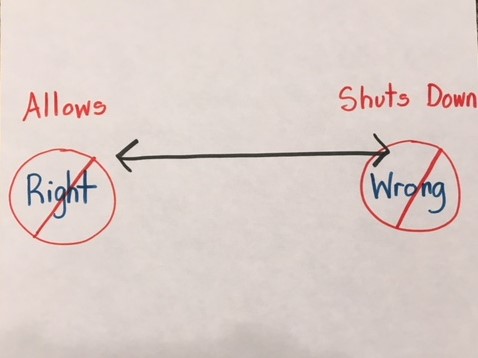
    Stephanie Jones, professor- and coach-extraordinaire, worked with a group of us coaches several years ago. Among the most impactful concepts she shared was letting go of “Right” versus “Wrong” and instead considering what each decision Allows and Shuts Down. 


    Every decision you make as a teacher (as a human, really) allows certain things to happen and shuts down other things. For example, consider the way you set up your classroom. You might push your students’ desks together in groups – this allows for more teamwork and better table-space for project work. But it shuts down some students’ ability to easily see the board (if their back is facing the front) and it might encourage student talk during those times you’d rather they listen to you.

    Or think about strategy-based reading groups, which is when you meet with kids reading at different levels and teach them a strategy before conferring with them individually. This approach allows you to provide targeted instruction regardless of reading level, thus giving you flexibility in forming groups. But it might shut down a common conversation that would be easier if everyone had a copy of the same book.

    In other words, strategy groups aren’t “wrong,” but they’re not always “right” either. You make your decision as a teacher based on what you want to allow for your students at that moment. The key is understanding that every decision you make simultaneously allows and shuts down certain things.

    Unfortunately, we will never Arrive at a point in our careers where we have this thing all figured out. We will never create the ultimate set of plans to save from year to year that will suffice for all students all the time. We will not find the One True Way to teach.

    The sooner we realize this and embrace the messiness of working with young minds, the sooner we can be kind to ourselves and find the joy in teaching.

    Wednesday, February 21, 2018

    Correcting the Fundamental Attribution Error


    It turns out that we’ve all made a critical error. And not just any error, but a fundamental attribution error. If it sounds terrifying, well, that may be only slightly off the mark.

    I read about this error in Richard Nisbett’s book Mindware: Tools for Smart Thinking  in which he describes “scientific and philosophical concepts that can change the way we solve problems by helping us to think more effectively about our behavior and our world.” It turns out that we are not nearly as smart as we think we are.

    Our problem is that we tend to attribute other people’s successes and failures to personal dispositions while we discount the context or circumstances that may have contributed to them. For instance, we might think of Todd as a lazy student, or of our co-worker Susan as standoffish and rude, or of Bill Gates as incredibly brilliant. We don’t take into account the circumstances that may have led to our perceptions. Nisbett digs into the Bill Gates story to reveal that when he was an 8th grader his parents transferred him to a different school because he was bored. His new school happened to be one of the very few schools in 1968 that was connected to a mainframe computer. This lucky break meant that he was able to log time on the computer and even test software for a local company. From there he began sneaking out of the house at 3am to spend time at the University of Washington computer center. If Gates had not transferred schools at that critical time, would he have become who he is today?

    Nisbett states, 
    “Behind many a successful person lies a string of lucky breaks that we have no inkling about” (p. 35). 

    We tend to assume it was the person’s characteristics rather than the surrounding circumstances that made them succeed or struggle.

    The kicker is that we do the opposite with ourselves – we, having the luxury of an intimate knowledge of our own circumstances, tend to give ourselves a break when we experience failure. We attribute our problem not to a personal traits, but to the situation. “Well, I would have gotten that job if I had not gotten a cold – I just wasn’t at the top of my game” or “The teacher doesn’t like me” or “The requirements aren’t fair.”

    The truth is, contexts and situations have a great deal to do with our behaviors. While we tend to think other people behave the way they do because of some innate characteristic (e.g. laziness, brilliance, greed) the reality is that life is a series of circumstances that make us into the people we currently are.

    This Fundamental Attribution Error has huge implications for teachers when we think about how we approach students, parents, and even our fellow teachers. I’ve been guilty of thinking Parent A “just doesn’t care” about their child’s needs in school, or that Teacher X just has a chip on her shoulder, or that my administrator is rude. But if it were me in those exact same circumstances I would cut myself a break by understanding how the current situation is making me appear as if I don’t have time for my child or that I’m too busy to socialize and be friendly with my co-workers or that my fracturing marriage is spilling over into negative interactions at work.  

    The bottom line is that we need to give each other a break. It can be hard to catch yourself doing this but, fittingly, it’s easier to catch someone else in the midst of committing the Fundamental Attribution Error. Once you begin to see it in others, you can notice it in yourself.

    Does this strike a chord for you? Do you notice yourself doing this with others? Have you discovered ways to catch yourself in the act of judging others and halt the judgment? Share in the comments below.

    Wednesday, February 14, 2018

    We're Never Using Scissors Again...

    The other day I was working with a group of Kindergarten teachers, otherwise known as the saints of the teaching world, when a second-year teacher gave me some words of wisdom that I think God intended me to hear. She lamented that the first time she tried to have her students use scissors it was a disaster. So much so that she went home and told her mom, a retired Kindergarten teacher, that they were never using scissors again. Ever.

    Her mom gave her some advice, which has been reverberating through my mind ever since: The first time you do ANYTHING with Kindergarteners, it’s a disaster. Just expect it. And know that it will get better the more you do it.

    I think that advice may not be just for Kindergarteners. It may apply to any person, or group of people, no matter their size.

    I think about the first time I tried to ride a Razor scooter – I’m lucky I didn’t end up at Urgent Care with a tree-shaped dent in my forehead. Or the first time I modeled a lesson in front of a teacher – the lesson went too long, I hadn’t planned out EXACTLY what to say during the think aloud, and the kids left the lesson confused and befuddled.

    I brought up this scissors story to a different group of teachers during a lesson study in which we decided to try revision stations from Kate Messner’s Real Revision . We planned each station, prepared the materials, and tried to anticipate students’ confusions. But the teachers were still worried that it wouldn’t work. Well, guess what? The first time, it probably won’t! It might even turn out to be a complete Kindergarten-Scissors disaster. But that doesn’t mean there’s not value in the attempt.

    If we gave ourselves room to have a nuclear-meltdown disaster every time we tried something new, and just expected it to not go well, then I’m guessing we might be pleasantly surprised at least half the time. And that’s a WAY better feeling than the anxiety and frustration that comes with expecting perfection and not getting it.

    Some might think this is a pessimistic way to look at things, but I actually think it’s the opposite. It’s giving yourself permission to flop at something the first few times you try it, to expect it to be less than perfect. And to be optimistic that it will improve a little, with every future attempt.

    Expecting disaster could make us more daring and willing to try a new strategy. And in the process we might end up being kinder to ourselves.

    Tuesday, February 6, 2018

    Which Matters More -- Type or Amount of Scaffolding?


    When reading with a student, which matters more – the amount of support you give the child when they encounter a difficult word, or the type of support you give?

    The answer might surprise you. In an article in the March/April issue of The Reading Teacher, Emily Rodgers describes her study of 10 Reading Recovery teachers and the level and type of scaffolding they provided students as they read. They separated the teachers into two groups – teachers who tended to have results above the national average for Reading Recovery and teachers who tended to have results below the national average.  To assess the level of support they evaluated teachers’ use of Wood’s (2003) tutoring rule: “When the learner runs into difficulty, the teacher should increase the amount of help provided, and when the learner experiences, success, the teacher should decrease the amount of help” (Rodgers, 2017, p. 527).  Rodgers found that there was no significant difference between the two groups of teachers. All teachers adjusted the level of their instruction appropriately about 61% of the time.

    Rodgers did, however, find a very significant difference between the two groups of teachers regarding type of support they provided. Students (and all readers, for that matter) use three cueing systems as they read: meaning, structure, and visual cues . Proficient readers simultaneously use multiple cues, while struggling readers tend to overuse one or two cues, often due to the instruction they’ve received (Schwartz, 2005).

    Rodgers found that high-performing teachers were eight times more likely to intentionally vary the type of support they gave in response to students by prompting them to use the missing cueing system. In other words, if a student over-relied on meaning cues (by misreading pony for horse or swing for playground) then these teachers prompted them to use more visual cues. If the reader overused visual cues (by saying visually similar nonsense words such as payund for playground, for instance) then the teachers prompted them to attend to meaning. This attention to the readers’ MSV errors and intentionality about their teaching response resulted in much higher success for students.

    It seems simple, right? Simply notice what the student is not doing, and prompt them to do it. But Rodgers cautions that we tend to find our “favorite” prompts and reuse them over and over again without regard to the child in front of us.

    She also cautions that just because there wasn’t a significant difference between the amount of support provided by the two groups of teachers doesn’t mean that we should stop adjusting how much support we give. All students in the study made some progress, and that could have been due to the teachers’ varying amount of support. Of course, if we don’t vary how much support we give, we will likely cause frustration in the student, which can be detrimental.

    I found this interesting, because I’ve written before  about amount and type of teacher scaffolding, but this study forwards the notion that tailoring our prompts for students to the quality of their miscues is by far the more important to attend to.

    What about you? Does this change your thoughts about how you confer with your students? Or how you work with small groups of students? Leave your thoughts in the comments below.

    Wednesday, April 12, 2017

    The Freak Factor


    I just finished a really interesting book by David Rendall, a speaker I heard at the ASCD 2017 conference. His book, The Freak Factor argues that your mother's advice to work on improving your weaknesses is entirely wrong. Instead, we should think of our weakness as uniqueness and flaunt it.

    His argument was pretty convincing, once I took the Freak Factor test he includes in the book. He demonstrates that every strength we have can also be perceived as a weakness: someone who is organized can also be seen as rigid; spontaneous people can also be too impulsive; creative people are often disorganized, and so on. My test showed that I am reflective and thoughtful, but that can come across as quiet and shy. I am analytical and rational, but that also comes with being critical and judgmental. I'm patient and cautious, but that is also the same as being slow and indecisive.

    Rendall's point is that if someone who is creative (and also disorganized) tried to work on becoming more organized, they'd be undoing the very thing that makes them unique. This is because their creativity is inextricably linked to disorganization. Altering one alters the other.

    Instead of trying to change ourselves, we should embrace our true nature, take the good with the bad. Rendall tells quite a few stories of people who tried unsuccessfully to go against their nature and ended up unhappy and in unfulfilling jobs. He argues that we should avoid the things we hate and find someone else who enjoys that task to do it instead. Just because you hate that task doesn't mean everyone hates it. Pay attention to what you procrastinate about - it's a sure sign that's not your strength.

    Overall, the book has me thinking about how to be happier in my life and stop fighting my own nature by trying to be something I'm not.

    Thoughts on what you feel like your strengths and corresponding weaknesses are? How might you embrace those?

    Wednesday, March 29, 2017

    Stress and ADHD


    That title may make you think of teacher stress as a result of kids having ADHD, however I'm really thinking about a comment Eric Jensen  made at the 2017 ASCD conference in California. His session was filled with rich nuggets of information, more than I could process at once, so I'm thinking his newest book will contain most of the information he covered.

    One particularly fascinating piece was about how the human body responds to stress. Chronic stress, the kind that comes from stressors occurring again and again (think about soldiers in a battle, or kids who are abused or beaten) creates not only physical changes to the brain due to high levels of cortisol (the stress hormone) but also behavioral changes. Kids will generally respond to stress one of two ways: 1) hyper-vigilance or 2) apathy. Kids will either “blow up” at very little provocation, or seem very unmotivated and as if they don't care. It brought to my mind the parents at high-poverty schools who can be extremely difficult to deal with, seemingly quick to anger and “go off” on the principal or teachers. Jensen explained that this hyper-vigilant behavior is an effort to control situations in a life that often seems out of control. If your world is crumbling around you, and it has been for a while, it makes sense that you do your best to take control the best (or only) way you know how.

    But Jensen also made another provocative comment: this hyper-vigilance due to chronic stress can look like distractibility, impulsivity, and hyper-activity. In other words, it looks just like ADHD. How many of our poverty students are being diagnosed with ADHD (or being blamed for having untreated ADHD) when in reality they may be under chronic stress? Are we treating the wrong problem?

    Eric has several recommendations for addressing student stress in schools:
    1. Relationship building
    2. Giving students more choice and control
    3. Teach stronger coping skills
    4. Learn to manage your own stress (as teachers)

    Would we have fewer students with ADHD in high-poverty schools if we followed these recommendations? What are your thoughts? Add your comments below.

    Wednesday, March 22, 2017

    Helping Students Read Closely in Authentic Ways


    Are your students struggling with deeply comprehending nonfiction texts? Have you heard about ‘close reading’ but aren’t sure what it is? Or have you been turned off by the plethora of professional books and workbooks that seem to teach close reading in overly procedural, basal-like ways?

    If this describes you at all, I can’t emphasize enough how much you will enjoy Kylene Beers and Bob Probst’s book “Reading Nonfiction: Notice and Note Stances, Signposts, and Strategies.” Kylene and Bob pull up alongside you, the reader, and provide just enough research, sprinkled with humor and stories from the classroom, to keep you turning the pages and believing that from now on your students will be masters at comprehending nonfiction.

    They begin by outlining three questions to teach students to ask themselves as a way to develop a questioning stance every time they read nonfiction:
    1. What surprised you?
    2. What did the author think you already knew?
    3. What changed, challenged, or confirmed what you already knew?
    Kylene and Bob then reveal the research they compiled about “signposts” that appear in nonfiction text to help students think about the Big Questions with more specificity. After reading about these five signposts I even find myself reading Time magazine and online articles differently. The five signposts are:

    1. Contrasts and contradictions (e.g. phrases that use key words such as however and on the other hand)
    2. Extreme or absolute language (e.g. words or phrases such as everyone on Earth or totally and always)
    3. Numbers and stats (i.e. Ask yourself – why did the author include these particular numbers?)
    4. Quoted words (i.e. Again, ask yourself – why did the author choose to quote this person?)
    5. Word Gaps (i.e. help students become aware of gaps in their understanding of vocabulary – oftentimes, these gaps are Tier 2 words used in unfamiliar ways such as an electrical charge or waves triggered by an earthquake).
    Finally, Kylene and Bob share seven strategies students can use before, during, and after reading to help clear up comprehension confusions. For instance, Syntax Surgery prompts students to draw arrows connecting confusing information such as vague pronouns to the supporting information elsewhere in the article. Another strategy, genre reformulation, encourages students to synthesize information after reading by recreating the information they read into an ABC book or a cause/effect sequence patterned after If You Give a Mouse a Cookie or Brown Bear, Brown Bear.
     
    Overall, this book is one of my absolute favorites, both for the richness of the ideas it contains as well as the comfortable, genuine style in which it is written. Teachers of students 2nd grade through high school should have this book on their nightstand.