Showing posts with label priorities. Show all posts

Saturday, August 15, 2020

K.I.S.S. = Keep It Simple Sister

If you are a teacher then chances are you're experiencing the most stressful August you’ve ever endured. Whether your school is about to open in-person, has already opened, or whether you’re teaching virtually, nothing about the beginning of school is normal this year. Nothing.

With so much to worry about this year (Will I get Covid? Will I pass it on to my loved ones? How do I keep students physically distanced at recess? How can I teach word study with my mouth covered by a mask? What happens when the little rugrats start shooting their masks at each other?) it would probably behoove us to take a deep breath and think about these two questions:

  1. What must we ABSOLUTELY get right during the first weeks of school?
  2. What can wait?

I’ve learned than when things get complicated, it’s best to react with simplicity. Distill down the most critical concepts and save the others for later.

What MUST we get right?

First, it is imperative that students feel safe and loved when they come to school. Some of our students are extremely anxious about picking up the virus, some have been in neglectful or abusive situations for the past five months, and others are simply “regular” anxious about the beginning of school. Our first order of business needs to be building trust and a sense of community so that these little people can relax. Eric Jensen has shown us that stressful situations release cortisol, and cortisol has distinct negative effects on people’s ability to learn. If our kids don’t feel safe and cared for, all the teaching we do will be for naught.

Secondly, we must create and follow procedures that will make future learning possible. If you are teaching in-person, that means all the new rituals and routines surrounding CDC guidelines: how do we line up safely without touching each other? When do we have to wear a mask? What do we do with our mask when we don’t have to wear it? How and when should I use hand sanitizer? How can I use classroom manipulatives safely? If you’re teaching virtually, students must understand your schedule, create a learning spot at home, and make a plan for sharing devices with siblings and parents.

All of this will be different this year, and it must be taught. Of all the things that are new, I think this is what stresses teachers the most because we’re trying to teach kids something we’ve never done before. Therefore, while this teaching-of-safety-routines is a must, we need to give ourselves grace while we work through it. Tell your students, “This is how we’re going to store our masks when we go to recess today. We might do it differently tomorrow or next week, but if we change I promise I’ll show you how so we can all get it right.” Flexibility is the name of the game for both teachers and students.

Finally, in these beginning weeks of school we must help students become familiar with technology and the platforms/tools our schools are using. Most likely our schools will be going digital at some point this year, or at the very least particular students or cohorts will go digital if they have to quarantine. They need to be comfortable logging in and navigating the platform. This can be done through games, scavenger hunts, and simple assignments that inspire confidence rather than fear in students (and parents!). If your students are beginning the year in a digital format, it’s even more important for them to be comfortable with the technology before you introduce grade-level concepts.

What can wait?

Honestly, deeper content and grade-level standards are not important in these first weeks. Give yourself and your kids a break and instead play games to build community and trust. You might toss in some concepts they learned last year, but make sure they’re easy concepts that your students are sure to have mastered. Nothing provokes anxiety more than being thrown two-digit multiplication when you’re still unsure about addition.

Another piece of the educational puzzle that can wait? Assessments. This may be a bit controversial, especially since we know our students will likely not be academically up to speed due to last spring’s Pandemic Pause. But I still come back to the great amount of stress students and teachers are under right now. Imagine if you were on a mission trip to a third-world country and when you arrived instead of allowing you to settle in, your hosts drove you to the middle of the capital and dropped you off to “assess” your ability to find your way to the mission compound? You’d have done much better if they’d just waited a short while and let you get the lay of the land. The same applies to students. Of course, teachers are constantly assessing in informal ways from day one – speaking vocabulary, behavioral strengths, small motor control, desire to read – and these can still be done during games and routines. Just save the formal assessments until kids have settled in.

"Don't let success go to your head. Don't let failure go to your heart." - Tim Keller 

We know these first weeks of school will be hard. The only thing that’s guaranteed is change. In these times of uncertainty, keep it simple. Love your students and let them know it. Create structure that will allow for deeper learning later. And above all, give yourself grace.

Wednesday, March 7, 2018

Let's Do Away With Right and Wrong

“I don’t know if this is the right way to do guided reading, but…”
“This is probably wrong, but what I do is…”
“Am I doing _______ (insert instructional approach here) correctly?”

If I had a dime for every time I heard someone say variations on these statements, I’d be able to go on that dream beach vacation I’ve always wanted.

Many of us teachers joined this profession because we were good students – we liked school, we felt comfortable there, and we want to replicate the joy of learning we felt growing up. And that’s a good thing! But being a good student oftentimes means we are people-pleasers who honor authority figures. We want to do the “right” thing the “right” way. Bless our hearts, we believe there actually IS a right way to do everything.

The other day I heard a coach friend of mine laughingly describe her first year of teaching. She bargained with her boyfriend – if he would just stick with her during this difficult first year, she agreed to get married, because after that she would have her first year of plans made and she could fall back on them from then on. Five years into it, her then-husband wanted to know why the heck she was still staying late at school and working on weekends – hadn’t she figured it out that first year or two?

One of the most unsettling realizations we can have as teachers often comes within the first 5-10 years of teaching, when we realize that Teaching Is Not Something You Master. There is never One Right Way to do anything.

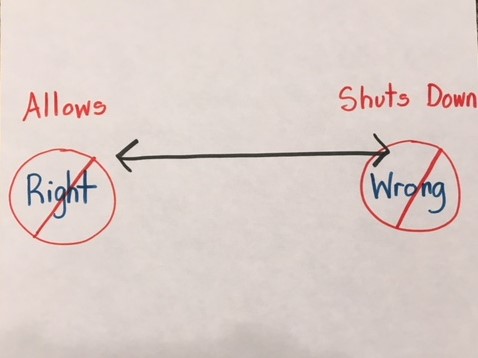
Stephanie Jones, professor- and coach-extraordinaire, worked with a group of us coaches several years ago. Among the most impactful concepts she shared was letting go of “Right” versus “Wrong” and instead considering what each decision Allows and Shuts Down. 


Every decision you make as a teacher (as a human, really) allows certain things to happen and shuts down other things. For example, consider the way you set up your classroom. You might push your students’ desks together in groups – this allows for more teamwork and better table-space for project work. But it shuts down some students’ ability to easily see the board (if their back is facing the front) and it might encourage student talk during those times you’d rather they listen to you.

Or think about strategy-based reading groups, which is when you meet with kids reading at different levels and teach them a strategy before conferring with them individually. This approach allows you to provide targeted instruction regardless of reading level, thus giving you flexibility in forming groups. But it might shut down a common conversation that would be easier if everyone had a copy of the same book.

In other words, strategy groups aren’t “wrong,” but they’re not always “right” either. You make your decision as a teacher based on what you want to allow for your students at that moment. The key is understanding that every decision you make simultaneously allows and shuts down certain things.

Unfortunately, we will never Arrive at a point in our careers where we have this thing all figured out. We will never create the ultimate set of plans to save from year to year that will suffice for all students all the time. We will not find the One True Way to teach.

The sooner we realize this and embrace the messiness of working with young minds, the sooner we can be kind to ourselves and find the joy in teaching.

Wednesday, April 12, 2017

The Freak Factor


I just finished a really interesting book by David Rendall, a speaker I heard at the ASCD 2017 conference. His book, The Freak Factor argues that your mother's advice to work on improving your weaknesses is entirely wrong. Instead, we should think of our weakness as uniqueness and flaunt it.

His argument was pretty convincing, once I took the Freak Factor test he includes in the book. He demonstrates that every strength we have can also be perceived as a weakness: someone who is organized can also be seen as rigid; spontaneous people can also be too impulsive; creative people are often disorganized, and so on. My test showed that I am reflective and thoughtful, but that can come across as quiet and shy. I am analytical and rational, but that also comes with being critical and judgmental. I'm patient and cautious, but that is also the same as being slow and indecisive.

Rendall's point is that if someone who is creative (and also disorganized) tried to work on becoming more organized, they'd be undoing the very thing that makes them unique. This is because their creativity is inextricably linked to disorganization. Altering one alters the other.

Instead of trying to change ourselves, we should embrace our true nature, take the good with the bad. Rendall tells quite a few stories of people who tried unsuccessfully to go against their nature and ended up unhappy and in unfulfilling jobs. He argues that we should avoid the things we hate and find someone else who enjoys that task to do it instead. Just because you hate that task doesn't mean everyone hates it. Pay attention to what you procrastinate about - it's a sure sign that's not your strength.

Overall, the book has me thinking about how to be happier in my life and stop fighting my own nature by trying to be something I'm not.

Thoughts on what you feel like your strengths and corresponding weaknesses are? How might you embrace those?

Thursday, August 4, 2016

The Power of Teachers


Years ago, on the first day of school, Nicholas walked into my classroom. Nicholas was a full head taller than the other kids, and though he wasn't necessarily older, he was much more confident than the other newly minted second graders. He hadn't come with his parents to “meet the teacher” afternoon earlier in the week, so I hadn't been sure he was still enrolled at our school, and yet here he stood at the door to my trailer classroom loudly asking the nearest kid, “This Mrs. Wall's class?” before walking in like he owned the place. His parents were nowhere to be seen - this 7-year-old had gotten off the bus, asked around, found our class, and simply presented himself. It was a perfect depiction of his personality in a nutshell, and it gave me a hint of how he would take charge of my class in the coming days.


Kids like Nicholas are in every classroom in the country. Kids with louder-than-the-teacher voices, kids who expect their classmates to obey them, kids who struggle with reading, and kids with very little parental support. It would have been very easy, that first morning, for me to harden my heart to Nicholas and mentally set him up to be the problem child, the negative mascot of the class who garnered most of my attention and whose name my husband would come to know from my daily rants.


Something was different that year, however, and for some reason I chose to really learn who Nicholas was and try to get inside his head. Perhaps it was because it was the second year I had done home visits with all of my students, and something about seeing these kids' earnestly cleaned bedrooms and their drawings on the refrigerator, and being introduced to the family pet while mom cooked Hamburger Helper suddenly brought into focus where school ranked in the overall picture of their lives. While I had Nicholas in my classroom for 6 ½ hours a day, there was another world in which he lived that we teachers had never seen.


Kids like Nicholas are why I love teaching. The power we hold in our hands as teachers is stomach-droppingly powerful. We decide whether a kid has a good year or a bad year. We can influence how a parent responds to their child, how that child feels about himself, and whether school becomes a place of love and safety or a place of shame and self-doubt. How we choose to respond to a child, every child, contributes to those children's beliefs about themselves and their own abilities for years to come. It's an awesome responsibility, and one we should be fully conscious of as we enter these first days of school.


My hope for teachers as this new year begins is that we all have the contemplative space we need in our days to be fully aware of this power we wield. Here's hoping we can come to understand the stories behind all of our little Nicholas's.


Monday, October 21, 2013

Savoring the Struggle


I've been reading a lot about inquiry learning lately, and the power of letting learners discover knowledge for themselves. This is true for learners of all ages - people from age 2 to 92 tend to remember and understand more deeply that which they had a hand in creating. A first grader who “discovers” that even numbers can be modeled by creating two matching columns of blocks to model a number will have a much deeper understanding than the child who memorizes, “2, 4, 6, 8…” The middle schooler who starts an interest-bearing savings account and the 35-year old who rebuilds his truck engine both learn life skills at a much deeper level than by simply reading a book about these events.

The key to inquiry, however, is struggle, and that something that's very hard for us teachers to allow. Letting a child struggle to accomplish something that we could help them solve with one or two well-placed comments requires patience and trust that eventually the student will master the task. It comes from a misunderstanding of where the learning is occurring - we tend to think the learning happens at the very end, when the math problem is solved, the engine is put back together or the savings account results in a longed-for purchase. But in reality, learning occurred during the period leading up to the final event. Without the struggle beforehand, facts are merely memorized and soon forgotten. No lesson is learned.

I'm reminded of a first grade teacher I knew many years ago while I was a reading specialist. I worked with several students from her class, and they would sometimes say, “Don't give me the fish!” while reading a text. When I asked the teacher to explain this, she told me that every year she would very dramatically act out the proverb “Give a man a fish and he'll eat for a day - teach a man to fish and you'll feed him for a lifetime.” She created a story from it, complete with a poor, bedraggled man becoming rich from all the fish he'd learned to catch.

She then connected it to the culture they were creating in their classroom - they promised each other that they would never “Give each other a fish” but instead would find ways to teach each other along the way. She told me the parents had been especially guilty of “giving fish” by providing the hard words during nightly reading, but the students soon put an end to that by teaching the parents to prompt them with strategies.

I've never forgotten that teacher's important lesson to her first graders. I unabashedly stole it to use in my classroom for years afterwards. Those kids knew the power in the struggle. They knew that being given a difficult word or told a math answer took away their right to learn for themselves. Allowing our students to struggle isn't easy, but it's the best way to ensure they truly learn.

Sunday, August 4, 2013

Fair Isn't Equal


It's the time of year when students and teachers are cramming in last-minute vacations before the fast-approaching first day of school. If you're a teacher, then most likely you're already dreaming “school dreams” at night and having day dreams as well. I always love the planning part of summer, when anything is possible and my optimist self foresees all my plans going perfectly in the upcoming year. Yep, THIS year I'll be organized, efficient, and downright inspirational to the best group of kids a teacher could hope to assemble in one place. Then reality hits as soon as every kid arrives bringing a bag of notebooks, folders, and reams of paper, none of which have their name on them, and somebody's crying and another one's mom wants to stay for the first 3 hours and my best laid plans are out the window before 8:15.

I do know, however, that however chaotic those first hours are in the classroom, one of the most important things I do during that crucial beginning time is to establish through my words and actions what kind of place this classroom will be for the 25 or so kids and I who inhabit it. Everything I say and how I say it is watched ever so carefully by kids those first hours, and so no matter how messy the pile of notebooks and folders, I have to prioritize and spend time creating community. My actions and words need to communicate that this is the kind of place where you'll be expected to think, where we value what you think even if we don't understand or agree with it, and where it's safe to be different and creative and even wrong.

Something I love to do on the first day, after everyone is settled and I've gathered everyone on the rug to tell them a little about myself, is to share with them an anonymous quote written large on chart paper: “Fair isn't equal. Fair doesn't mean everyone gets the same. It means that everyone gets what they need.” We talk about what this means, and how my job is to figure out what each one of them needs and their job is to help me find that out. Everyone in our classroom is different and has differing needs. One person might need me to help them come up with ideas for writing while another person might have plenty of ideas but need help organizing them. Some of them might love multiplication but need help with fractions, while others are just the opposite. People are complicated beings, which is why teaching isn't easy, but it's always interesting.

As I'm explaining this, all their faces are turned towards me, listening intently, not really sure what I mean. Some of them want to trust me, but if they've struggled in school they may be wary of being the one that's “different,” the one who sits in the special desk or sees the teacher every day for interventions. They don't really trust that I'll treat everyone's needs differently or that I'll ask their opinion about why they feel the need to distract other kids in circle time or that I really do want to hear about the fort they built behind their house during a writing conference. That will come later.

For now, they have homework: find out from their parents at exactly what age they learned to walk, say their first word, and lost their first tooth. We spend the next few days charting these facts so that I can once again reinforce the idea that we're all slightly different, just like snowflakes. And if our bodies grow at differing speeds, reaching these milestones at different times, then our minds and how we think develop the same way: at different speeds and at different times, but we all DID eventually lose our first tooth, right? We all did learn to walk and talk. So too will we all learn the things we're setting out to learn this year, but it won't happen at the same time for each one of us. And that's perfectly okay, because that's only natural.

It's my job to find out exactly what they need as students, and it's our job as a classroom community to help each other get there. It should be what being in school is all about.

Monday, May 6, 2013

Identity Crisis


How does a teacher early in her career decide who she’s going to be? My first year I had grand ideas of changing the world, but quickly learned it took all of my time just to keep my head above water. I kept telling myself, “It’s ok. I’m only a first year teacher.” And later, “It’s alright, this is only my second year.” But by the third year, I was really beginning to doubt myself, and definitely by the fourth year I was pretty sure I was irreparably damaging the tiny souls in my care. “What’s wrong with me?” I’d silently scream to myself. “It’s already my fourth year and I still don’t know what I’m doing!”

Fortunately, sometime during that fourth year, an experienced teacher at a county-level meeting reassured me this was completely normal. No one else had bothered to explain that self-doubt comes with the job. Instead, when I looked around me I saw what appeared to be confident, organized, experienced teachers who never doubted their next steps and always had their plans ready for next week. Granted, their plans involved basal texts and grammar worksheets, but at least they left on time on Fridays and could joke around with the principal. “Maybe I should just be the kind of teacher who pulls the same Leprechaun file out for March each year,” I thought. “Just go ahead and buy the polyester pantsuit and a pack of red pens."

After recently talking with young teacher also caught in the 4th-year slump, I’m beginning to think this is a natural stage creative teachers must go through. Perhaps it’s an identity crisis, a search for your true self, which occurs when you realize that it’s not easy to become the larger-than-life teacher you’d set out to be when you were a wide-eyed undergrad. You wonder: if that remarkable teacher you intended to become hasn’t arrived yet, maybe it won’t ever happen, and instead you should begin to look around to find another model to settle for.

I’m not sure what brought me out of that slump – it’s been too many years ago to remember the details – but I do think it might have had to do with a change of scenery. I moved schools and separated from my more traditional teammate. I also joined some county-level committees that gave me a wider perspective, but more importantly allowed me to see even experienced teachers were still struggling to nail down this profession. And probably most importantly, I found an unofficial mentor, a neighboring teacher who was ten times more creative than me. Sherry gave me someone to emulate and motivated me to become more than who I was. She served as my “mentor text” and reaffirmed my budding beliefs in student choice and active learning that had almost gotten squashed during my earlier years.

Perhaps you’re a new teacher hitting that identity slump, wondering if you’ll ever be the teacher you’d aspired to. Or maybe you have passed that rough patch and feel fully vested in the identity you’ve carved out for yourself in this difficult profession. In either case, reach out to each other. Lord knows we all need support.

Friday, April 27, 2012

Pineapple Implosion

Testing mania has officially reached the pinnacle of absurdity. In an effort to make every square peg of text fit into the round holes of standardized tests, and the seemingly parallel goal of sucking every bit of enjoyment out of the act of reading, New York recently tested students on a tongue-in-cheek fable written by Daniel Pinkwater. He’s the author of books such as The Hoboken Chicken Emergency , Adventures of a Cat Whiskered Girl and Mrs. Noodlekugel , none of which I’ve read. However, it doesn’t take a genius to recognize his books contain an offbeat sense of humor that appeals to boys, quirky kids, and the creative right-brainers of the world.

Take a look at the passage from the test and the subsequent questions. How would you answer them? I’ll wait while you go visit the site….

Thoughts?

Here are mine: reading on a standardized test is not the same as reading for enjoyment or for intrinsically-motivated information-seeking. When we read test passages we’re searching for the one right answer – by definition we’re not allowed to think outside the box or answer divergent questions. The most successful test-takers see it as a game where they try to “beat” the test creators.

“The Hare and the Pineapple” is not a story intended for literal comprehension. It would be like giving a college student their final exam on an episode of Jon Stewart’s The Daily Show or treating Saturday Night Live as if it’s a documentary on American life from PBS. The fact that the Pineapple story was treated with such seriousness makes me feel that we’ve lost sight of our purposes. Not to mention our reason.

Standardized tests can give us some good information. But it can’t take the place of reading for enjoyment, and it certainly shouldn’t kill it. Please – leave some stories for kids to enjoy for the pure fun of reading, and give us at least a fighting chance of creating readers out of the students in our classrooms.

Tuesday, April 10, 2012

The Voices in Our Heads

When’s the last time you read aloud to your class? Or if you’re a coach or administrator, when’s the last time you walked by a classroom or dropped in when the teacher was reading aloud to her kids?

The fact is, many of us could probably say our read aloud sessions are few and far between. As the pressures of teaching have increased, and the test looms over the not-so-distant horizon this spring, anything that has the stench of “enjoyment” and that can’t be directly tied to an increase in test scores is abandoned in favor of activities that are.

But it’s not just during testing season that reading aloud books falls by the wayside. Too many people (teachers, administrators) feel if kids are listening to a book, or even interactively responding to a read aloud book, that rigorous instruction is not being provided. “You can’t just read for fun! There’s too much to do – skills must be drilled, worksheets must be worked upon, and circles must be bubbled.”

Recently, I had the good fortune to hear Katie Wood Ray speak at the National Reading Recovery Conference in Columbus, Ohio. She was a keynote speaker, talking in front of about 2,000 Reading Recovery certified (and those of us who were not certified) teachers about the power of reading aloud.

Kids deserve to hear the beauty of language spoken aloud, she said. They need to build a knowledge base of what good writing sounds like – otherwise, when we ask them, “Does that sound right?” they won’t know. Students need to practice reading their own writing aloud, which she practices herself when she writes professional books for teachers. It’s what makes books eminently readable – the sense that there’s a person behind the words, that it sounds like spoken language.

Katie led us in an exercise that made a big impression on me. First she posted on a large screen a memoir piece by Cynthia Rylant from “The Milestone Project” and she asked us to read the entire piece to ourselves. Then she read aloud, slowly, in her sweet Southern voice, and she let herself linger over some parts, pause at others, and luxuriate in the words. She then asked us to read the last paragraph to ourselves again, but this time to read it with her voice inside our heads, and as I did I realized that her voice was slowing me down, forcing me to slow at commas, stop abruptly at dashes, that before I’d quickly rushed through on my way to finishing the piece. Her voice echoed in my head, and I really did enjoy the piece, and connect with six-year-old Cynthia on her way to the school bus in the dark, much better than I had the first time.

The point, Katie says, is that when we read aloud, this is the gift we give our kids – to let them hear our voices inside their heads. When we listen to someone who really enjoys reading aloud it enhances our understanding of the characters and allows us to tie ourselves to them emotionally.

But for kids who don’t hear text read aloud, how will they know how it’s supposed to sound? How will they know how to write in ways that make their stories come alive to others? Will they connect as deeply to characters without the sounds of their dialogue echoing through their heads? Or without the sound of our read-aloud voices echoing as well?

Monday, May 30, 2011

Coaching/Real Estate

I learned a lesson about coaching from my real estate agent. It wasn't a lesson about coaching as much as it was about relationships, which of course is at the heart of coaching.

Our real estate agent, Shannon, helped us buy what we consider to be the perfect house and piece of property several years ago. While I'd like to think we weren't as demanding or self-absorbed as some couples she might work with, we still wanted to see a range of houses and get a feel for the market, and so she patiently drove us from house to house for weeks. When we found a place we thought we loved, she toured it with us for hours contemplating the pros and cons, and suggesting options without ever pushing her opinion. She was an exceptional listener, really looking at each of us as we spoke, weighing our comments before responding, and never interrupting.

But the biggest thing she did was making us feel like we were her only clients. I know for a fact that, in a market that was very depressed, she was closing on more houses than most other agents in the area - that's why we'd chosen her. So she obviously had quite a lot of other deals going on simultaneously. And yet she never mentioned them. She didn't leave us with, "I'm off to attend a closing" or say, "I've got to take this call from other clients." We felt like the center of her world.

As a coach juggling many teachers, it's tempting sometimes to join in the general complaints with others about how busy we all are. I've caught myself rushing a conversation by explaining where I needed to be next, or apologizing for not getting to an email because I was working with someone else.

Teachers don't want to know that. They want to feel like they're the center of our world. And they deserve to be, just as kids deserve to feel like they're the center of their teacher's world.

It's a basic human need, to be listened to and truly heard. We all value it when someone is looking us full in the face, considering everything we're saying, and not simply juggling multiple ongoing thoughts in their head as we talk. Someone said, and I'm paraphrasing here, "In America, we've lost the ability to have a true conversation. People no longer listen to each other. Instead, they reload."

Shannon taught me the value of setting everything aside and truly being wherever you are. For coaches, the teachers we work with deserve to feel like our number one priority

Sunday, January 23, 2011

Different Paths

I’ve been reading Georgia Heard’s “A Place for Wonder” about reading and writing nonfiction in the primary grades, and in the latest section she’s had the 1st graders brainstorm things they wonder about and then sort them according to whether they’re “research wonders” or “heart wonders” (meaning it’s more opinion-based, such as “What makes a best friend?”). She recounts her conferences with various children and the few questions they’re not sure how to categorize, or which they categorize differently than an adult might. For instance, one little girl puts the card for “How do oceans get made?” into the heart pile, and when Georgia asks why, it’s because to this little girl the ocean is an enormous place of mystery and she has no concept of the scientific aspects of it. Different than many teachers would, however, Georgia and her co-teacher Jen don’t correct her, realizing there’s time later on for this child to discover the potential of research to re-categorize it on her own.

It didn’t matter whether the distinctions were exact but rather that the children understood that there are various ways to go about exploring questions.

(p. 69) That’s a very “free-ing” statement, one that I remember feeling quite often as I read books from the various New York teachers connected to Teacher’s College or Denver’s PEBC – things like, you don’t have to complete a picture book all in one sitting, or it’s ok not to have literacy centers, or think of your day as a menu of options rather than a to-do list. Too often, nowadays, it seems teachers don’t hear enough free-ing statements, and instead feel more tied down by regulations and expectations.

Heard’s quote above caused me to think about my work as a coach as well. In the same way that she and Jen didn’t worry about the correctness of their students’ responses right away and instead gave them room to find them on their own, as a coach my concern should not be that teachers correctly implement a teaching strategy right away as much as it should be about giving them room to think about and explore it on their own. Coaching is more about the conversations we have about our teaching, not a search for one correct way of doing it. If these first graders had the freedom to grow their own confidence in their abilities as researchers, then shouldn’t teachers feel that same freedom to explore what works with kids? I did that for years as a teacher in a school without a coach, and the role I’d have liked the coach to serve would not have been as “fount of knowledge” but rather sounding board for successes and failures; a conversation partner about teaching.

There’s never only one way to do something. As coaches we should be able to encourage teachers to take different paths to common outcomes.

Saturday, August 14, 2010

First Week

It's Saturday after the first full week of school, and I have spent the day in recovery - mostly napping and rubbing my feet, trying to recharge the batteries. I always seem to forget how tough beginning the year is once the adrenaline and excitement wear off.

It's different as a coach, of course, and this time of year is when I miss having my own class the most. As coaches, we end up supporting classroom teachers as they set up rules and routines during these first weeks, and it's still exhausting work.

Yesterday evening, as I finally left the building, I thought back over my week of duties which had frankly felt more like putting out forest fires than anything truly constructive, and I felt disappointed by the lack of true coaching duties I felt I'd performed.

But as I reflected on it more, I think it may be a natural phase every year, perhaps at every school, that we focus more on operational procedures during those first days, and less on refining our instructional practices. It's a necessary thing to have all hands on deck to make sure classes proceed through the lunchroom on time, kids make it out of the building safely for the first fire drill, classes are balanced as new kids arrive, and kindergarteners find their classrooms. I may not be able to look back over the first days and feel like an effective coach, but it's very similar to what we tell teachers: spend those first weeks working on rules and routines so that you can be more effective in your instruction later on. Our time spent making sure teachers have enough textbooks and passing out "Welcome back to school" treats will pay dividends later on when we ask them to trust our opinions and as we coach through tough classroom situations.

However, it's critical that we don't get stuck in these operational tasks. We have to be able to step back after a week or so, find our true purpose, and pass many of these duties on to assistant principals or others whose job it truly is, or otherwise we'll find ourselves halfway through the year with nothing to show from our job as coach. I'd much rather end the year as exhausted as I began it, but from having coached my heart out in the months between.

Saturday, June 5, 2010

Breathing In and Breathing Out

The past week has been a wonderful blur of sleeping late, piddling in the yard, and fictional books that have nothing to do with teaching. It was the first full week off for summer vacation, and I reveled in it, to the point that when asked by a friend to discuss an educational topic towards the end of the week, I found that I didn’t have the “education-ese” ready at the tip of my tongue. My brain had taken a much-needed rest and had promptly forgotten so much of what I’d worked on for the past 200 days.

Sylvia Ashton-Warner, in her book “Teacher”, talks about arranging her day with the Maori children of New Zealand as an alternation between “breathing in” and “breathing out”. She felt that kids need to balance taking in new information with their creative impulses to produce something, and so she layered her day with, for instance, whole-group big book reading followed by independent writing time, then singing songs and reciting rhymes as a whole group followed by small group projects. This approach gives kids a chance to process and apply all the new information they hear during the day. It’s why a pure lecture method doesn’t work, even for adults.

As a teacher and coach, I find that I need to balance my “breathing in” with my “breathing out” as well. There are only so many professional books I can read, or even so many pages of one professional book I can take in, before I must take a break and put it to use. It’s also why I am a fairly slow reader when it comes to reading professionally – I spend a great deal of time staring off into space processing what I’ve read. The time spent staring is directly proportional to the unfamiliarity or originality of the material I read. But by balancing that breathing in and out as I read, I’ve been able to process the material by applying it virtually to situations in my classroom.

There’s a rhythm to a productive life, a groove that, once we fit into it, feels just right. And sometimes what feels just right is to piddle in the yard and take a complete break from breathing at all.

Wednesday, April 21, 2010

The Rocks and Sand of Coaching

If there’s one thing I hear more than anything else from other instructional coaches, it’s the frustration with the multitude of tasks competing for our time and the struggle to find the time to get everything done that we need to. So many coaches, myself included, look back on periods of time (the past week, month, day) and wonder what, exactly, we accomplished for all the energy that we expended.

Despite our district having a clearly defined evaluation tool that outlines the expectations for our job, coaches often end up spreading themselves an inch deep and a mile wide. It’s as if the evaluation tool is considered a “minimum bar”, similar to the “recommended passenger limit” on a subway car, and the school faculty or administration are the uniformed people on Japanese subways pushing “just one more” passenger in until the doors almost burst from overload. Many coaches around the country are doing tasks that stretch the definition of coach: substituting when subs cannot be found, helping at field day, providing interventions or enrichment activities for students, copying papers for teachers, or creating master schedules.

Somehow, we’ve got to figure out how to prioritize what’s most important for coaches to be doing. It reminds me of a metaphor I once saw for prioritizing the big, important things in life: if you consider your life to be a jar into which all the events in your life must fit, and the most important things are rocks, while the least important things are sand, it becomes obvious which you should fit into the jar of life first. If you allow the little things in life - the sand – to take priority, then there’s no room left over for the bigger important “rocks”. But if you make space for the rocks first, then all the sand will trickle through and find a way to fit. Only then will you have a balanced life with room for the things most important to you as well as those little things that just come up.

Coaches need to find a way to fit in the big rocks of coaching teachers and let the sand of “little things that come up” trickle through and find their own space. First we must decide: what are those big rocks of coaching? Is it modeling in classrooms? Extended time spent with a teacher gradually releasing instruction? Conversations with teachers exploring professional decision making? Once those big rocks are found, then they must be given priority, and that involves convincing your administration of the importance of the big rocks, and the inconsequence of the sand.

How have you been able to prioritize the important things in your life?