Showing posts with label coaching. Show all posts

Saturday, August 15, 2020

K.I.S.S. = Keep It Simple Sister

If you are a teacher then chances are you're experiencing the most stressful August you’ve ever endured. Whether your school is about to open in-person, has already opened, or whether you’re teaching virtually, nothing about the beginning of school is normal this year. Nothing.

With so much to worry about this year (Will I get Covid? Will I pass it on to my loved ones? How do I keep students physically distanced at recess? How can I teach word study with my mouth covered by a mask? What happens when the little rugrats start shooting their masks at each other?) it would probably behoove us to take a deep breath and think about these two questions:

  1. What must we ABSOLUTELY get right during the first weeks of school?
  2. What can wait?

I’ve learned than when things get complicated, it’s best to react with simplicity. Distill down the most critical concepts and save the others for later.

What MUST we get right?

First, it is imperative that students feel safe and loved when they come to school. Some of our students are extremely anxious about picking up the virus, some have been in neglectful or abusive situations for the past five months, and others are simply “regular” anxious about the beginning of school. Our first order of business needs to be building trust and a sense of community so that these little people can relax. Eric Jensen has shown us that stressful situations release cortisol, and cortisol has distinct negative effects on people’s ability to learn. If our kids don’t feel safe and cared for, all the teaching we do will be for naught.

Secondly, we must create and follow procedures that will make future learning possible. If you are teaching in-person, that means all the new rituals and routines surrounding CDC guidelines: how do we line up safely without touching each other? When do we have to wear a mask? What do we do with our mask when we don’t have to wear it? How and when should I use hand sanitizer? How can I use classroom manipulatives safely? If you’re teaching virtually, students must understand your schedule, create a learning spot at home, and make a plan for sharing devices with siblings and parents.

All of this will be different this year, and it must be taught. Of all the things that are new, I think this is what stresses teachers the most because we’re trying to teach kids something we’ve never done before. Therefore, while this teaching-of-safety-routines is a must, we need to give ourselves grace while we work through it. Tell your students, “This is how we’re going to store our masks when we go to recess today. We might do it differently tomorrow or next week, but if we change I promise I’ll show you how so we can all get it right.” Flexibility is the name of the game for both teachers and students.

Finally, in these beginning weeks of school we must help students become familiar with technology and the platforms/tools our schools are using. Most likely our schools will be going digital at some point this year, or at the very least particular students or cohorts will go digital if they have to quarantine. They need to be comfortable logging in and navigating the platform. This can be done through games, scavenger hunts, and simple assignments that inspire confidence rather than fear in students (and parents!). If your students are beginning the year in a digital format, it’s even more important for them to be comfortable with the technology before you introduce grade-level concepts.

What can wait?

Honestly, deeper content and grade-level standards are not important in these first weeks. Give yourself and your kids a break and instead play games to build community and trust. You might toss in some concepts they learned last year, but make sure they’re easy concepts that your students are sure to have mastered. Nothing provokes anxiety more than being thrown two-digit multiplication when you’re still unsure about addition.

Another piece of the educational puzzle that can wait? Assessments. This may be a bit controversial, especially since we know our students will likely not be academically up to speed due to last spring’s Pandemic Pause. But I still come back to the great amount of stress students and teachers are under right now. Imagine if you were on a mission trip to a third-world country and when you arrived instead of allowing you to settle in, your hosts drove you to the middle of the capital and dropped you off to “assess” your ability to find your way to the mission compound? You’d have done much better if they’d just waited a short while and let you get the lay of the land. The same applies to students. Of course, teachers are constantly assessing in informal ways from day one – speaking vocabulary, behavioral strengths, small motor control, desire to read – and these can still be done during games and routines. Just save the formal assessments until kids have settled in.

"Don't let success go to your head. Don't let failure go to your heart." - Tim Keller 

We know these first weeks of school will be hard. The only thing that’s guaranteed is change. In these times of uncertainty, keep it simple. Love your students and let them know it. Create structure that will allow for deeper learning later. And above all, give yourself grace.

Wednesday, September 4, 2019

Emotional Baggage

I have a love/hate relationship with one of the key parts of my job as a coach. On the one hand, I love dropping into classrooms to talk with students about what they’re working on or to do an impromptu conference. On the other hand, it feels very much like a “power move” to me, something that only someone of authority, like an administrator, has the ability to do. I worry that it aligns me with the evaluation side of administration, and yet I also feel like I need to see the current instruction happening in the school in order to plan “best fit” professional learning for our staff.


So then imagine my inner turmoil after this recent visit to a second grade classroom. The teacher is conferring with a student at the back table while all the other students are spread out around the room. I bypass the kid closest to the door and sit next to, let’s call her Kayla, who has her feet comfortably propped up on her desk as she reads a graphic novel version of Captain Underpants. “How’s it going?” I ask. “Can you read me a little bit of your book?”

Kayla glances at the book. “Well, I can’t really read the words. I just tell what’s happening from the pictures.”

“Let’s give it a try,” I tell her enthusiastically. “Maybe I can help you with the hard words.” Kayla proceeds to labor through three frames of the text, needing help with many of the words.

“Hmmmm,” I mention after having helped her with supposed and joke. “I’m thinking this book might not be a just right book for you yet. That doesn’t mean it won’t be later, but we probably need to find some books that are a better fit for you.”

Kayla begins to cry. “But I want to read chapter books like the other kids are doing!” she says. “That’s my best friend over there,” she gestures towards a girl reading a Magic Treehouse book, “and she’s reading a chapter book and I want to read one too!” Her voice is starting to get louder.

“Not everyone reads the same kinds of books at the same time, and that’s ok,” I tell her, but she buries her head in her arms and begins to cry loudly. “Let’s try reading one of these other books you have in your bag,” I say as I pull out two books labeled as level 10 texts and then Ralph S. Mouse, which I quickly set to the side.

“Those are baby books! They’re too easy! My auntie says I have to read chapter books to get to be a better reader,” Kayla cries.

“Why don’t you show me how easy they are?” I ask, and I pull out Cookie’s Week and open to the first page. Sure enough, she reads smoothly and accurately, though she substitutes “windshield” for “windowsill” and doesn’t want to hear about that error.

“I want to read chapter books like the others! I don’t want everyone to know I can’t read!” she wails loudly enough for everyone in the class to hear. At this point a blonde girl nearby brings her another leveled reader that apparently Kayla had been reading yesterday. Not helpful. It’s not a chapter book.

“How about this?” I whisper, “What if I can find some books for you that are chapter books that you CAN read? Will you come to the media center with me to find those books?” I’m wracking my brain trying to think of a low-level chapter book – maybe Nate the Great? Ivy and Bean? Did we buy some Hi-Lo books for 3rd and 4th grade last year?

It doesn’t matter, because Kayla has completely fallen apart, wailing loudly, bottom lip quivering, hiccupping and gasping for air. Her teacher mouths, “I’m sorry!” to me, shaking her head. Apparently I’m fighting an old battle and have opened up old wounds.

“Why did you come in here?” Kayla wails loudly, “Everything was fine until you got here!”

I feel for Kayla. She was not at all shy about her dilemma – she’s very aware that she’s reading at a level lower than the others, and it’s breaking her heart. She has a vested interest in keeping up appearances, and that involves holding thicker books during reading time and being able to tell her friends that she reads chapter books. If I want to ensure she makes progress this year, this is a critical moment in her reading life. I need to find her books that look hard but are easy to decode.

I quickly walk down the hall and burst into the media center. Fortunately, it’s empty. “I have a reading emergency!” I announce to the media clerk. “Where are your Nate the Great or similar books?” She quickly directs me to the early chapter books and we find a few – Owl Diaries, which might be a bit on the high side, but is a graphic book with heavy picture support; Unicorn and Yeti, an even easier graphic book with three chapters; and two more books with heavy picture support, fairly simple sentence structure, and most importantly - chapters.

I run back to Kayla’s class, where she is still crumpled on her desk, crying quietly while everyone else sits on the rug for writing time. After some coaxing, I convince her to come to a back corner of the room to look at the books I’ve brought. “Are they chapter books?” is the first thing she asks, so we flip through each, looking at the tables of contents and chapter headings. Instantly, her tears dry up.

“Let’s read a few pages of one of these – which one would you like to try?” I ask. Quietly, she chooses Unicorn and Yeti and then she literally crawls into my lap, dries her tears, and begins to read. She still needs some help, and we study the pictures a good deal to understand the context, but after reading four pages, she is beaming. “Thank you!” she whispers.

Later that day as I see her class on their way to lunch she breaks out of line and runs up to me. “I read more of those books you got me! I’m taking them home to my auntie to show her I can read chapter books!”

At the time, I didn’t realize quite what had happened for Kayla. Honestly, for a while there, I thought I’d broken her. There’s nothing quite like a wailing, blubbering reader to make you feel like a conference failure.

But all Kayla wanted is what we all want – to be loved by our friends, which to her meant fitting in by reading the same types of books they had. As a teacher, our jobs are to meet kids where they are while simultaneously helping them with the emotional baggage that comes with being a struggling reader. Thankfully, there are texts that can help with this. But it’s also important to realize that without Kayla’s buy-in and emotional confidence, nothing I said to her about reading strategies would stick. She needs first to feel like she belongs, that she’s in a safe zone with her peers. Once she has that comfort, we’ll be able to work on cracking the nut of finding the skills and strategies she needs as a reader.

Wednesday, January 23, 2019

Book Review: Onward – by Elena Aguilar


This jewel of a book is one you’ll want to read very slowly so that you can stretch out the experience. It has taken me months to read it, and even now I’m sad it’s over. Elena knew it would likely have this effect, because she’s organized each chapter around a month of the year, beginning with June.

The book is about cultivating resilience in educators. Each chapter examines aspects of resilience such as emotional intelligence, storytelling, taking care of yourself, compassion, and dealing with change. Along the way she takes deeper dives into specific emotions such as optimism, empathy, and perfectionism. Each page gave me so much to think about and reflect upon that I felt the need to slow down to digest, but also share with others.

For instance, she begins the short section on perfectionism saying, “At the heart of perfectionism is the belief that, in order to be loved and accepted, we must strive to act and be the best all the time” (p. 166). This isn’t possible, of course, and so along with perfectionism comes frustration and even anger when things don’t work out perfectly. Understanding this helps me understand some people I know who at first glance appear to be angry much of the time, but underneath it all may be frustrated perfectionists. Education is certainly a difficult field if you’re constantly striving for perfection.

Her chapter on change made a big impression on me as well. Appropriately, she fit this into the April chapter, which in education is the month of testing and finding out the big changes for next year – the principal’s not coming back, or you’re asked to teach a new grade level. Change is incredibly stressful. The secret to leading change, Elena says, is to understand that most people are fearful of change, and as leaders we must acknowledge this and lend encouragement. There’s no fast way through this. “Leading change most often includes learning; in order for people to do something different, whatever it is that you want them to do, you need to address skill, knowledge, capacity, will, cultural competency, and emotional intelligence” (p. 280). She suggests setting up opportunities for teachers to reflect on their purpose and their ongoing growth. And above all, to listen.

As teachers, we all feel a complete range of emotions throughout the year. If you have lately been feeling less bounce in your step, less resilience in the face of challenge, I urge you to pick up this book. Each time I set it down after reading, I felt better, more encouraged, and filled with food for thought. Treat yourself to this book – you deserve it.

Wednesday, April 18, 2018

Why aren’t they doing what I taught them?


Recently I spent the morning facilitating a lesson study with K-2 teachers and an afternoon meeting with coaches only to find that both groups were having problems with the same basic idea – lack of transfer from instruction to independent work. For the teachers, they felt they had taught students lesson after lesson about editing writing for punctuation, spelling, and capital usage, but students were unable to correct the work on their own. If teachers pointed out the errors, students recognized them and could fix them, but they weren’t finding the mistakes on their own.

With the coaches, the concern was that the teachers they worked with had watched them model workshop and mini-lessons, but when coaches dropped by classrooms the teachers weren’t necessarily putting the work into practice. Instead, unannounced visits revealed teachers reverting back to the instructional methods they’d previously used.

In both of these cases, instruction had happened, but wasn’t sticking. Why?

There could be lots of reasons, but I wonder if it has to do with the gradual release model not being gradual enough. When we think about “I do” moving into “we do” until finally “you do,” I’m not sure we’ve really thought about the different variations of “we do” deeply enough. Within that large middle section of “we do,” how might we intentionally back off our support in ways that translate to confidence on the part of the learner?

Perhaps part of the confusion lies in how long gradual release should take. I wonder if the teachers discussing writing conventions felt like they had gradually released sufficiently since over the course of the mini-lesson they’d modeled and had kids work with partners? But what if it takes longer than that? Are we building in enough time for kids to discuss their options and work through the difficulties? Do the materials we model with closely match the students’ materials, or are they just different enough to confuse those extra-literal students? Are we giving kids the concrete steps or strategies they need in order to walk through the editing process?

In thinking about gradual release as it applies to coaching, perhaps we’re also cutting gradual release too short. Just because we’re working with adults doesn’t mean those adults don’t also deserve to receive a great deal of “we do” support from the coach.

That might mean the coach co-plans and co-teaches more lessons with the teacher. It might mean asking the teacher to videotape her teaching in order to capture “the work” for you both to reflect on. It might mean building in more intentional reflection time after lessons in order to point out on-the-fly decisions and to look at the resulting student work.

And what about our so-called “you do” segment? Are we really expecting learners, whether children or adults, to apply what they’ve learned in completely solo environments? What if we built in support through partnerships by coaching two teachers instead of one, so there’s a built-in talk-partner for times the coach is not available?

These are just a few of my current ideas on why our work might not be sticking, whether it’s with students or adults. I need to do a lot more thinking about this. What are your thoughts? How can we make sure that the work we’re doing is effective and transfers to independence?

Wednesday, March 7, 2018

Let's Do Away With Right and Wrong

“I don’t know if this is the right way to do guided reading, but…”
“This is probably wrong, but what I do is…”
“Am I doing _______ (insert instructional approach here) correctly?”

If I had a dime for every time I heard someone say variations on these statements, I’d be able to go on that dream beach vacation I’ve always wanted.

Many of us teachers joined this profession because we were good students – we liked school, we felt comfortable there, and we want to replicate the joy of learning we felt growing up. And that’s a good thing! But being a good student oftentimes means we are people-pleasers who honor authority figures. We want to do the “right” thing the “right” way. Bless our hearts, we believe there actually IS a right way to do everything.

The other day I heard a coach friend of mine laughingly describe her first year of teaching. She bargained with her boyfriend – if he would just stick with her during this difficult first year, she agreed to get married, because after that she would have her first year of plans made and she could fall back on them from then on. Five years into it, her then-husband wanted to know why the heck she was still staying late at school and working on weekends – hadn’t she figured it out that first year or two?

One of the most unsettling realizations we can have as teachers often comes within the first 5-10 years of teaching, when we realize that Teaching Is Not Something You Master. There is never One Right Way to do anything.

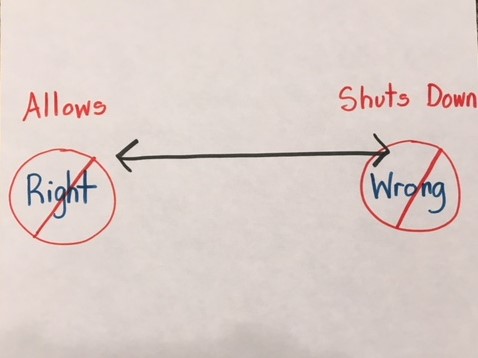
Stephanie Jones, professor- and coach-extraordinaire, worked with a group of us coaches several years ago. Among the most impactful concepts she shared was letting go of “Right” versus “Wrong” and instead considering what each decision Allows and Shuts Down. 


Every decision you make as a teacher (as a human, really) allows certain things to happen and shuts down other things. For example, consider the way you set up your classroom. You might push your students’ desks together in groups – this allows for more teamwork and better table-space for project work. But it shuts down some students’ ability to easily see the board (if their back is facing the front) and it might encourage student talk during those times you’d rather they listen to you.

Or think about strategy-based reading groups, which is when you meet with kids reading at different levels and teach them a strategy before conferring with them individually. This approach allows you to provide targeted instruction regardless of reading level, thus giving you flexibility in forming groups. But it might shut down a common conversation that would be easier if everyone had a copy of the same book.

In other words, strategy groups aren’t “wrong,” but they’re not always “right” either. You make your decision as a teacher based on what you want to allow for your students at that moment. The key is understanding that every decision you make simultaneously allows and shuts down certain things.

Unfortunately, we will never Arrive at a point in our careers where we have this thing all figured out. We will never create the ultimate set of plans to save from year to year that will suffice for all students all the time. We will not find the One True Way to teach.

The sooner we realize this and embrace the messiness of working with young minds, the sooner we can be kind to ourselves and find the joy in teaching.

Wednesday, February 21, 2018

Correcting the Fundamental Attribution Error


It turns out that we’ve all made a critical error. And not just any error, but a fundamental attribution error. If it sounds terrifying, well, that may be only slightly off the mark.

I read about this error in Richard Nisbett’s book Mindware: Tools for Smart Thinking  in which he describes “scientific and philosophical concepts that can change the way we solve problems by helping us to think more effectively about our behavior and our world.” It turns out that we are not nearly as smart as we think we are.

Our problem is that we tend to attribute other people’s successes and failures to personal dispositions while we discount the context or circumstances that may have contributed to them. For instance, we might think of Todd as a lazy student, or of our co-worker Susan as standoffish and rude, or of Bill Gates as incredibly brilliant. We don’t take into account the circumstances that may have led to our perceptions. Nisbett digs into the Bill Gates story to reveal that when he was an 8th grader his parents transferred him to a different school because he was bored. His new school happened to be one of the very few schools in 1968 that was connected to a mainframe computer. This lucky break meant that he was able to log time on the computer and even test software for a local company. From there he began sneaking out of the house at 3am to spend time at the University of Washington computer center. If Gates had not transferred schools at that critical time, would he have become who he is today?

Nisbett states, 
“Behind many a successful person lies a string of lucky breaks that we have no inkling about” (p. 35). 

We tend to assume it was the person’s characteristics rather than the surrounding circumstances that made them succeed or struggle.

The kicker is that we do the opposite with ourselves – we, having the luxury of an intimate knowledge of our own circumstances, tend to give ourselves a break when we experience failure. We attribute our problem not to a personal traits, but to the situation. “Well, I would have gotten that job if I had not gotten a cold – I just wasn’t at the top of my game” or “The teacher doesn’t like me” or “The requirements aren’t fair.”

The truth is, contexts and situations have a great deal to do with our behaviors. While we tend to think other people behave the way they do because of some innate characteristic (e.g. laziness, brilliance, greed) the reality is that life is a series of circumstances that make us into the people we currently are.

This Fundamental Attribution Error has huge implications for teachers when we think about how we approach students, parents, and even our fellow teachers. I’ve been guilty of thinking Parent A “just doesn’t care” about their child’s needs in school, or that Teacher X just has a chip on her shoulder, or that my administrator is rude. But if it were me in those exact same circumstances I would cut myself a break by understanding how the current situation is making me appear as if I don’t have time for my child or that I’m too busy to socialize and be friendly with my co-workers or that my fracturing marriage is spilling over into negative interactions at work.  

The bottom line is that we need to give each other a break. It can be hard to catch yourself doing this but, fittingly, it’s easier to catch someone else in the midst of committing the Fundamental Attribution Error. Once you begin to see it in others, you can notice it in yourself.

Does this strike a chord for you? Do you notice yourself doing this with others? Have you discovered ways to catch yourself in the act of judging others and halt the judgment? Share in the comments below.

Wednesday, February 14, 2018

We're Never Using Scissors Again...

The other day I was working with a group of Kindergarten teachers, otherwise known as the saints of the teaching world, when a second-year teacher gave me some words of wisdom that I think God intended me to hear. She lamented that the first time she tried to have her students use scissors it was a disaster. So much so that she went home and told her mom, a retired Kindergarten teacher, that they were never using scissors again. Ever.

Her mom gave her some advice, which has been reverberating through my mind ever since: The first time you do ANYTHING with Kindergarteners, it’s a disaster. Just expect it. And know that it will get better the more you do it.

I think that advice may not be just for Kindergarteners. It may apply to any person, or group of people, no matter their size.

I think about the first time I tried to ride a Razor scooter – I’m lucky I didn’t end up at Urgent Care with a tree-shaped dent in my forehead. Or the first time I modeled a lesson in front of a teacher – the lesson went too long, I hadn’t planned out EXACTLY what to say during the think aloud, and the kids left the lesson confused and befuddled.

I brought up this scissors story to a different group of teachers during a lesson study in which we decided to try revision stations from Kate Messner’s Real Revision . We planned each station, prepared the materials, and tried to anticipate students’ confusions. But the teachers were still worried that it wouldn’t work. Well, guess what? The first time, it probably won’t! It might even turn out to be a complete Kindergarten-Scissors disaster. But that doesn’t mean there’s not value in the attempt.

If we gave ourselves room to have a nuclear-meltdown disaster every time we tried something new, and just expected it to not go well, then I’m guessing we might be pleasantly surprised at least half the time. And that’s a WAY better feeling than the anxiety and frustration that comes with expecting perfection and not getting it.

Some might think this is a pessimistic way to look at things, but I actually think it’s the opposite. It’s giving yourself permission to flop at something the first few times you try it, to expect it to be less than perfect. And to be optimistic that it will improve a little, with every future attempt.

Expecting disaster could make us more daring and willing to try a new strategy. And in the process we might end up being kinder to ourselves.

Wednesday, March 15, 2017

4 Key Ways to Teach a Concept (Part 2 – Professional Learning)

Recently I was thinking about the four ways of teaching a concept to students and how some of these methods are more helpful than others, when it hit me – these four ways of teaching also mirror the ways we experience learning as adults. And in much the same way as with students, some methods work better than others in particular settings.

As a quick review, the four ways to teach a concept are: demonstration (modeling), guided practice, explicitly telling and showing, and inquiry. As teachers, we may experience demonstration when a coach or consultant models lessons, and we might learn through guided practice as we try a new strategy and receive immediate feedback from the coach. Very occasionally we may engage in inquiry groups. More often, however, professional learning entails “explicit telling and showing” or the “sit and get” model. Each of these methods have very different structures and require different types of thinking from participants. It’s worth thinking about the type of learning and thinking required of each method.

My guess is that most teachers experience “explicit telling and showing” as their main form of professional development. Or maybe it’s more just “telling and showing” without much explicit-ness. These are the after-school faculty meetings when a coach, consultant or administrator shares the latest, greatest method for close reading or word study instruction or whatever new approach has come down the pike. If we’re lucky, we are somewhat active participants and get to try the strategy with a partner, but more often we sit and listen to a PowerPoint being read slide by slide. It brings to mind the viral quote I saw not long ago:


Research shows that simply being told something does not transfer to classroom instruction. And yet, many schools and districts continue this method as the primary form of staff development…

I have found it to be much more effective to provide professional learning in a coaching lab approach, in which I meet with teachers during the school day so that we can work with actual students and try out the methods we’re learning about. We usually begin with theory and discussion about the topic, then move on to a demonstration lesson with students and finally guided practice as the teachers partner up to practice with small groups of students. The feedback I get from teachers afterwards is usually very positive – people enjoy seeing the teaching strategy in action, and after initial trepidation, they really like seeing each other teach – a luxury that is oddly absent in our profession. My sense from talking with teachers is that they’re much likelier to bring the teaching method back to their own classrooms after having tried it with colleagues in the lab.

Another method I’ve found to be very successful is Lesson Study This approach uses inquiry, the fourth method for teaching a concept. Lesson study involves teachers creating lessons to address a common problem of practice, then taking turns teaching the lesson while their colleagues watch the effects on the students. It may be the most nontraditional method of professional development most teachers experience, and it can be very difficult to facilitate, but it often results in deep reflection and feelings of empowerment for the participants.

One final thought about these four methods as they pertain to thinking: over-use of “explicitly retelling and showing” tends to lead to a procedural approach to teaching, a sort of “here’s what you need to know to be able to be successful, just follow these steps or guidelines.” Procedural learning leads to procedural teaching.

In contrast, modeling a teaching strategy, then providing teachers time to engage in guided practice is less about discrete procedures and more about deep processes. These approaches, along with inquiry learning, honor the difficulty of the teaching profession, and invite teachers to engage in and explore the complex choices we must make in the act of teaching. Teaching cognitive processes IS rocket science, and cannot be accomplished by following a series of procedural steps.

There will be times when a concept is simple enough to call for the procedural thinking that comes from “explicitly telling and showing,” but I argue that both teachers and students deserve to experience the process learning that comes with modeling, guided practice, and inquiry learning.

Monday, August 29, 2016

Questioning Game for Coaches

I recently attended a great conference on The Art of Coaching hosted by Elena Aguilar, the author of the book The Art of Coaching . I've read a lot of books on coaching over the past ten years, but Elena's perspective stands out because of her commitment to social justice throughout the text. She helps us move beyond looking only at the interaction between coach and teacher to consider the implications of systems thinking, systemic oppression and change management, among others. Her book is changing how I think about coaching, and I have a feeling I'll be referring to it in future posts as I digest and attempt to apply her approach.

Elena mentioned that in coaching interactions, the coach should only speak about 1/3 of the time. This stems from her belief about coaching, which I paraphrased as: Most of the time, people are able to solve their own problems. Therefore, coaching should be about helping people solve their own problems. To do this, we need to let teachers talk, we need to draw out their beliefs and help them connect these to their actions, we need to tap into who they are being and who they want to be, and we need to understand their core values.

Over the course of the two day conference, I realized that I am much more tempted to solve people's problems for them, in an effort to be helpful and speed things along, instead of doing the harder and often more time-intensive work of helping them grow themselves so that they can solve future problems on their own.

To get better at this, I think I need to start by listening more, so I'm going to attempt something I'll call the Questioning Game. It's based on those Improv game shows where contestants can only ask questions:


I'm wondering if making myself ask a series of questions will encourage the person I'm with to think through their dilemma and possibly solve it themselves. I imagine it might go something like this:

Teacher: I'm really worried about my low group of kids. Their DRA scores show they're reading more than a year below grade level and a lot of them struggle with writing anything more than a couple sentences.
Coach: What have you tried so far?
T: Well, they all go to Mrs. Y for intervention and she's working with them on sight words and some of the comprehension strategies. But they miss most of my writing mini-lesson because they're gone to intervention, so I'm worried that they're falling even farther behind in writing.
C: Do the kids have to leave during that time? Is there a way to rearrange the schedule to make it work?
T: Well, unfortunately the intervention teacher's schedule is tied to everyone else's schedule, so I don't think she can pull them at another time. [pause] I wonder if I could move my mini-lesson back a little so they could be here for that and leave when we do independent reading?
C: Would you feel better about that?
T: I think so. Then they'd get to hear the mini-lesson from me AND receive intervention.

Of course, it can get awkward to answer everything with a question, so if I'm ever at a loss on a question to ask - like the comedians in the clip, there's a point at which you draw a blank - then rather than trying to solve the problem for the teacher, I'll try to restate what they've just said. I find that easier when restating emotions: It sounds like you're frustrated with this situation for instance.


In today’s stressed world, it can be tempting to take the “most efficient” route by solving people’s problems for them. But then they don’t own the solution, and can leave the interaction feeling less energized and empowered than when they arrived. So, my new goal is to ask more questions and act as a mirror by restating the thinking teachers are doing as they talk with me. I’ll let you know how it goes… 

Tuesday, August 16, 2016

Facing Down Imposter Syndrome


Becoming a coach is not an easy transition. Actually, part of being human is realizing that there are no easy transitions - becoming a teenager, moving to a new home, getting a divorce - most change is hard for us fragile beings.

I suppose much of it comes from discomfort with a lack of control. Most of us like feeling that we know what we're doing, and transitioning to a new place or a new position puts us in a place of Wobble, as my friend Bob Fecho calls it. Wobble is good however - it means we're changing, growing, and learning, becoming more than we were before. But it is also often uncomfortable.

Sometimes, those of us in this period of change subscribe to what is called Imposter Syndrome, or the feeling that we should “fake it til you make it." Imposter Syndrome is that uncomfortable feeling that you SHOULD know something, that others are depending on you for the answers, and that to not know them would appear weak. It can manifest as a feeling of guilt or shame or even in some cases in defensive behaviors such as anger.

I remember as a new coach, in a new building of teachers I didn't know, I felt I had WAY more questions than answers to give people. After several days of telling folks I would get back to them, I didn't feel like I'd helped anyone with any thing. I wasn't at all sure that they'd hired the right person for my job, that perhaps I'd just be better off going back to the classroom where at least I knew what I was doing. I remember wishing I could skip the next two years and just magically become an experienced coach who knew the answers.

If I'd had the words to label what I was feeling as Imposter Syndrome, I think it would have helped. I needed to know this was a perfectly normal feeling for a new coach, or even for a new teacher or new principal. I wish I had confided these feelings to someone, and that they had advised me to enjoy the Wobble that came with this new experience. There would only one time in my life I would be a new coach, and I could learn a lot from the experience if I only let myself reflect on it, pay attention to it, and use it.

If this is you this year, or if your next door neighbor down the hall is new this year (to the school, or the grade level, or to teaching), watch for the ugly evidence of Imposter Syndrome and do your best to squash it. Instead, tell yourself (or the other person) to enjoy the Wobble as a sign of growth. Embrace the chance to stretch yourself. And know that to not know something is never a sign of weakness. It is, instead, a sign of transition as our fragile selves change into something new.

Sunday, August 25, 2013

Two Theories Diverged...


This past week I had somewhat of an epiphany as I was working with a large number of Juniors and Seniors at the College of Education from our local university. They'd asked that I give a three and a half hour overview of literacy, Common Core standards, and anything else they thought might be helpful to kids at the beginning of their careers.

Three and a half hours is a long time, especially to the students who were hearing a lot of information all at once. But I tried to build a foundation from the beginning by starting with educational theory. It was the discussion of theory that led to my epiphany.

My basic approach was to talk about two major theories of learning that teachers tend to have - the transmission theory and constructivist theory. Transmission theory holds that the teacher possesses knowledge that must be transmitted to students, who are simply receptacles. This is also called the banking method - the teacher makes “deposits” in the students' knowledge, slowly adding to their overall understanding over time. The students' job is simply to receive the knowledge and remember it. The problem with this approach is that it views the learner as passive and uninvolved, and doesn't value the knowledge the learners bring with them. It also tends not to stick, because the learner doesn't value or relate to the information. Teachers who believe in transmission theory will often say, “I don't know what's wrong with these kids - I told them what to do and they just won't do it.” The implication is if the students don't learn there must be something wrong with them because the teacher did her job.

Social constructivist theory, on the other hand, holds that learners construct their understandings by combining new knowledge with old knowledge. In order to understand a concept at a deep level, such as how to infer character motivations in a classic novel, the learner must draw from both the text (new information) and previous experiences (old knowledge) to infer, for instance, why Atticus Finch chooses to defend a black man in “To Kill a Mockingbird”. A teacher believing in the transmission model would explain the character's motivations to the students, while those using social constructivist theory would ask students to talk about it, drawing on what they already know about the time period and human nature. Social constructivist teaching takes longer, but it's relevant learning that remains with the student after the teacher is gone.

I'm beginning to realize, as a coach working with teachers and other coaches, that oftentimes what I see as stubbornness or resistance to new ideas is actually a clash between my learning theory and theirs. Underlying all instructional moves, assessment decisions, or classroom management strategies is the instructor's theory, and if I don't first understand that, I can't hope to effect change.

I need to think about this further, but so far I have several things I wonder about:

  • Does everyone consciously know their own theory of learning? My guess is they don’t so then, as a coach, how do I help them tap into that?
  • Is constructivist theory always best? Are there times when transmission is the preferred method?
  • What language can I use as a coach that is the least threatening, and allows people to freely examine their learning theories without feeling defensive?

What about you? What is your theory of learning?

Saturday, April 27, 2013

Explicit Coaching


Recently I overheard a coach conferring with a teacher about a lesson the teacher wanted to see modeled. “What I’d really like to see,” she said, “is how to work with my stronger readers on the reflection and interpretation questions similar to those on the DRA. Could you work with a guided reading group on that?” The coach agreed and set a date for the lesson.

I waited for more conversation to happen, but none did. I thought the coach might probe for what specifically the kids were having trouble with, or she might think aloud about how she could address these higher-order skills in a guided reading group, how she might model thinking aloud to the kids or think through which book to use. But none of this happened – the conversation moved on to other kids in the class who struggled.

Perhaps this coach and teacher will meet again before the modeled lesson, but it made me realize that one of the hardest parts of coaching, especially when we’re new to coaching, is remembering that we’re not there to teach the students. We’re there to make our teaching moves explicit to teachers. We have to make the implicit explicit, and that’s not always easy.

Many of us are “unconsciouslycompetent” – we’ve been teaching effectively for so long that we’re no longer conscious of why we do the things we do. We teach like we drive – automatically, effectively, and unconsciously. Perhaps one solution is to practice narrating our driving on the morning commute: “See what I did just then? That truck up ahead put on its blinker to pull into the deceleration lane, so I automatically glanced in my rearview mirror. I need to know how close someone might be following me before I apply the brakes.”

In the classroom this might mean saying, while modeling a reading conference, “At this point, I’m deliberately ignoring the minor oral reading errors I hear in order to keep the focus of the conference on comprehension. Otherwise I run the risk of overwhelming the student with too many teaching points.” These types of automatic, subconscious decisions are what highly-effective teachers do, but if we don’t lift them to a conscious level then some teachers may continue to be left in the dark.

Effective coaching makes implicitly good teaching explicit. It’s about sharing our thinking in the midst of the acts of teaching. That includes sharing the thinking that goes into planning instruction, the myriad small moves that happen in the course of a lesson, and the reflection after a lesson is complete. As coaches, we must move beyond unconscious competence into becoming reflectively competent.

Saturday, February 18, 2012

What's the Underlying Message?

If there's one thing I've learned during my work over the past few years, it's that words matter. Whether they're spoken, emailed, or Tweeted, what we say and how we say it can often be two different things. Many times, we're not even aware of the competing messages we send.

I have a friend who I often talk to about teaching and coaching, and I realized after a discussion the other day that she often begins her sentences to me, "You need to..." rather than, "What about..." or "Have you thought of..." The difference is subtle, but the underlying message of the former is, "I have the answer" and it can be quick to shut down divergent discussion.

In working with a group of teachers earlier this summer, I learned from a participant to ask, "What questions do you have?" rather than, "Does anyone have any questions?" because the message then becomes, "I fully expect questions and don't judge you for having them".

Every year as the school year gets ready to begin, I like to reread Peter Johnston's book "Choice Words". My copy is heavily highlighted so I can skim the book within an hour. He argues eloquently that our words in classrooms have immense power to create efficacy and identity in children. Debbie Miller, featured often in his book, is a master at giving children power with her words: "You really helped me think through that part" she tells a student and "You solved that word by rereading and chunking". The underlying message is, "You did the work, and I merely witnessed your brilliant thinking".

I'd argue (and have before) that the same applies to coaching. Cathy Toll says a coach should never ask a question she already feels she has the answer to. So, we should never say, "Have you thought about making your mini-lessons shorter?" That's not really a question. It's a statement about the length of the current lesson. Asking a convergent question sends the message that the coach knows best, that she's searching for the "right" answer, and it automatically disrupts the power balance in a coaching relationship.

It's helped me to always step out of my shoes in conversations with teachers and put myself in their place. How will what I'm about to say come across? If I were them, would I feel motivated to continue our discussion? Or would I want to shut down? What underlying message am I sending?

Sunday, December 11, 2011

Coaching Labs

Oftentimes in education, we treat teacher professional development as if it in no way mirrors best practices for students, when in reality what’s good for kids is good for those who teach them. This has become much more obvious to me as our county has begun implementing coaching labs based on the approach used by Lucy Calkins and her colleagues at Columbia University.

The model is built on a gradual release framework with the idea that teachers should have the chance to learn about a new approach to teaching, see it modeled with live students, co-plan and co-teach students with a colleague using the new approach, and then receive support as they implement it in their classrooms.

I’ve been piloting this approach over the past year and while some labs have gone very well, others have flopped. I’m beginning to find some guidelines that may help ensure labs are successful:

• Make sure teachers know the structure of the lab from the beginning. The time commitment is a big one – usually 90 minutes once a week for a series of weeks. Almost every time teachers begin the lab feeling resentful of the time commitment and not at all convinced it will be useful. Explain the focus of the labs and quickly give them valuable experiences to create buy-in.

• Be sure the lab has a specific focus and revisit that focus at each and every meeting. Too often we address topics that are too large – narrow the focus down. Instead of “guided reading”, make it more about the quality of the prompts during guided reading. Instead of “conferences”, make it about how to find the teaching point for average and above average readers. If something else comes up during the labs, don’t go chasing rabbits. Make a note for a future lab, but keep the focus on your intended teaching point. Otherwise you dilute the potential power of the labs and teachers will ask afterwards, “What was the purpose of what we did?”

• Allow teachers to have a say in the focus of the lab. Have a pre-lab meeting to ask teachers about their instructional needs. Dig deeply in the discussion to find that specific focus you’ll use in the labs.

• Be intentional about the structure of each lab. It should mirror the workshop approach of mini-lesson, work session, and sharing. Begin with information for the teachers specific to their work with children that day (the mini-lesson), have teachers work with or see you work with actual students (work session), and then debrief afterwards (sharing). Don’t allow the debrief session to be left off – this is where some of the most powerful thinking occurs.

• Broaden the debrief session. Too many times, the tendency will be to discuss the particular students the teachers just observed. A part of the debrief should concern these kids, but then the discussion should pretty quickly transfer the key understandings of this lab to the teaching happening in the teachers’ classrooms. Ask open-ended, divergent questions to get people thinking about their own practice.

• Don’t allow too much time between lab sessions. Each lab should build on the previous one, and if too much time elapses before teachers meet again the learning that occurred can be lost. At most, allow 2 weeks between sessions.

• Monitor the transfer to classroom instruction. As the lab sessions progress, teachers should begin to apply more of what they learn to their classroom practice. Coaches need to be there every step of the way, offering to model in teachers’ classrooms or co-teach lessons for added support. Teachers might also benefit from observing each other in their classrooms. Informal walk-throughs can let you know how comfortable teachers are with transferring learning from the lab to their classrooms.

This is at least a starting point towards conducting a successful coaching lab and avoiding some of the pitfalls I’ve fallen into with less productive labs. Much of the feedback I’ve gotten regarding the labs has been very positive – teachers have enjoyed the hands-on approach and the sense that it met their needs and allowed them to be reflective about their practice.

As one participant said,
“Small group learning with practice on real students (because adult learning is really not that different than what works well with children!) is so much more meaningful than sitting in a big room watching someone click through a PowerPoint.”

Monday, December 5, 2011

Coaching Openings

I remember the first time I worked my way into co-teaching in a classroom with a teacher because it happened completely unintentionally. When I began coaching I was naïve enough to believe that if people wanted help, they’d come right out and ask. It only took the first few months of aimlessly waiting to realize that I could gather cobwebs and dust before someone might trust me enough to outright ask for help.

Instead, that first opening came as so many since have – in the form of griping. A third grade teacher came to our coach’s office to complain about all the demands being asked of her and the stress of trying to make writing workshop work with “these kids”. I nodded sympathetically, but my colleague – the experienced literacy coach – recognized it for what it was: an opening to coach. “Heather just came out of teaching 3rd grade,” she commented, “she’d be glad to help out during your writing workshop and lend a hand”.

Sure enough, once I was in her room I found I could offer solutions and help her problem-solve the issues her kids were running into. But if my colleague hadn’t helped me see her griping as an invitation, we both still be in our individual rooms, each frustrated with our particular situations.

Most of the time, coaching openings are just as subtle as this one was. I learned my lesson that time, and became much more adept at hearing pleas for help stated in different languages – sometimes it came in the form of tears of frustration, or bursts of anger, or confusion about testing results. Sometimes teachers came at me sideways, asking for one thing when they really wanted help with another. And after quite a while, a few people began to trust me and started asking outright if I’d come assist with particular kids or instructional situations.

No matter how long I’ve been coaching, I’ve always got to be ready to respond to openings. Sometimes the best openings are camouflaged in subtle ways.

Sunday, October 30, 2011

Elevator speech

Business people say that everyone should have an elevator speech ready to explain what you do at your job. By elevator speech, they meant a short synopsis of your career that could be explained to a stranger in the time it takes to rise a few floors on an elevator.

I’ve tried for a few years to come up with my elevator speech and when people ask what I do I’ve said such things as, “Well, I’m a coach, but not an athletic coach. I sort of cheer teachers on.” But that’s not right. Or, “I’m a teacher of teachers – I help them find the best instructional strategies for the classroom.” But that implies that I’m the one with all the knowledge, when in fact I’ve learned as much from other teachers as I’ve taught them. It’s certainly not, “I walk the halls and make sure teachers have what they need and do what they should” or “I basically wait around in my office until someone comes to ask me a question or cry on my shoulder.” Describing coaching can be hard.

But then the other day we had a business associate of my husband’s over for dinner and rather than ask, “What grade do you teach?” when he found out I was in education, he asked, “What do you do?” I surprised myself by saying, “My job is about change. I offer teachers support as they change their practice.”

That’s about as succinct as it gets. Coaching is about change. It’s about nudging change to happen, supporting it as it does, questioning when it doesn’t, and celebrating when it succeeds.

What’s your elevator speech?

Monday, October 10, 2011

The Possibility of Being Wrong

A while back I read an email from a teacher about an issue that I thought had been taken care of by a third person months ago, only to find out that appeared it hadn’t. Student well-being was at stake, and as I read and reread the email I found myself getting more and more upset. I vented to my office-mates and talked myself into a frenzy before vowing to “go take care of it right now!”

However, upon talking to the third party in question I quickly realized that I’d misunderstood the entire task, it HAD been taken care of months ago, and I’d just made and a** of myself in front of her, and possibly burnt some bridges I’d need later on.

This doesn’t happen to me too often, but when it does it causes me to sit back and re-evaluate my impulses. I should have counted to 10 (or 200) and waited to calm down before addressing the situation. And I should have entertained the possibility that maybe I was wrong in this case. There have been so many times that I have been wrong, you think I’d be used to it by now.

Too many times as coaches, we feel like we know the right way of doing things, the right instructional technique, the right materials to use, the right person for the job, the right solution to a problem. But the best coaches, in my experience, are the ones who approach a situation with an open mind, a questioning stance, and a willingness to entertain others’ ideas. Yes, you may feel that there is one “right” way to do guided reading, but what if this teacher’s adaptation is what works for her students? Or what at first appears to be a hallway display of very convergent, narrow thinking may, upon deeper inspection, be a truly creative way to teach inferential thinking.

From now on, before I make judgments, I vow to take stock of the situation and ask myself, “but what if I’m wrong?” If I ask questions and stay open-minded, perhaps I can build more bridges than I burn.

Thursday, July 28, 2011

5 Goals for this Year

I recently read Justin Tarte’s blog entitled “My 10 Goals as a First Year Administrator” and it inspired me to think about my goals for the coming year. I’m not in my first year and I'm not an administrator, but it’s never too late to have goals. As a matter of fact, summer is the perfect time to sit back and rethink my views on coaching.

1. I will – work more on my “teddy bear” aspects since I’m so clearly a “magnifying glass” (see here)
2. I will – ask more questions and do less telling.
3. I will – make my coaching student-centered rather than teacher-centered.
4. I will – take deep breaths during stressful situations. Under stress I tend to become shorter in speech and faster in action, neither of which is conducive to building relationships with others.
5. I will – be compassionate. “Always be kinder than necessary, for everyone you meet is fighting some kind of battle.” ~ Plato

Education is one of the few professions that allows us to start anew every 12 months. Wherever you are in your journey as an educator, if you took the time to think of changes for the upcoming year, what would they be?

Monday, May 30, 2011

Coaching/Real Estate

I learned a lesson about coaching from my real estate agent. It wasn't a lesson about coaching as much as it was about relationships, which of course is at the heart of coaching.

Our real estate agent, Shannon, helped us buy what we consider to be the perfect house and piece of property several years ago. While I'd like to think we weren't as demanding or self-absorbed as some couples she might work with, we still wanted to see a range of houses and get a feel for the market, and so she patiently drove us from house to house for weeks. When we found a place we thought we loved, she toured it with us for hours contemplating the pros and cons, and suggesting options without ever pushing her opinion. She was an exceptional listener, really looking at each of us as we spoke, weighing our comments before responding, and never interrupting.

But the biggest thing she did was making us feel like we were her only clients. I know for a fact that, in a market that was very depressed, she was closing on more houses than most other agents in the area - that's why we'd chosen her. So she obviously had quite a lot of other deals going on simultaneously. And yet she never mentioned them. She didn't leave us with, "I'm off to attend a closing" or say, "I've got to take this call from other clients." We felt like the center of her world.

As a coach juggling many teachers, it's tempting sometimes to join in the general complaints with others about how busy we all are. I've caught myself rushing a conversation by explaining where I needed to be next, or apologizing for not getting to an email because I was working with someone else.

Teachers don't want to know that. They want to feel like they're the center of our world. And they deserve to be, just as kids deserve to feel like they're the center of their teacher's world.

It's a basic human need, to be listened to and truly heard. We all value it when someone is looking us full in the face, considering everything we're saying, and not simply juggling multiple ongoing thoughts in their head as we talk. Someone said, and I'm paraphrasing here, "In America, we've lost the ability to have a true conversation. People no longer listen to each other. Instead, they reload."

Shannon taught me the value of setting everything aside and truly being wherever you are. For coaches, the teachers we work with deserve to feel like our number one priority

Sunday, May 22, 2011

The Guilt of Teaching

Lately I’ve been conferring with lots of teachers about their literacy practices and their instructional goals for next year, and I’m being reminded just how much guilt factors into teaching. It seems like everyone begins with apologetic statements about how badly they feel about their _____ (trouble fitting in conferences, long mini-lessons, lack of closing/sharing on workshop, need to differentiate literacy centers, etc.). No one has come to me and said, “I feel great about all I’m doing! I think I’ve got teaching down pat and I’m really beginning to think it’s getting a little too easy.”

It’s natural to want to do the best you can at any job, but in education the responsibility of knowing a child’s self-concept and future is on the line causes us to be more critical than perhaps some other professions. As teachers, we’re expected to do it all and there’s simply no way we can. So we feel guilty.

Show me a teacher who doesn’t feel guilty about at least some part of her teaching and I’ll show you a teacher who’s not being reflective. But as I said – my guess is you can’t show me that teacher because she doesn’t exist…