Tuesday, January 1, 2019

8 Professional Books You Should Read


Everyone’s coming out with their favorite books from the past year, and though I’m a little late I thought I’d jump on the bandwagon. To keep it simple, I’m restricting my list to professional books only, though I read SO many good novels this year too.

This book tops my list mainly because I just finished it a few days ago and it’s still on my mind daily and will continue to be. Through so much of it I found myself nodding, and wondering how she put into words what I’ve intuitively felt and known about how we make decisions around comprehension instruction. Her writing style is filled with references to her work with students, so it automatically feels trustworthy, and while her ideas are complex, they make complete sense. It’s a book I’ll want to revisit a few times. Overall, her premise is that we should take a problem-based approach to our work with kids. Vinton suggests that we’ve been doing too much of the work for kids – that we’ve over-scaffolded their thinking, and thereby prevented them from practicing the work they’ll soon be doing on their own, when we’re not by their sides. Step-by-step she shows us how to create deeper thinking readers through mini-lessons, small group work, and conferences. This is a great book for anyone familiar with workshop who wants to take their instruction to the next level.

Understanding Texts and Readers by Jennifer Serravallo
I blogged about this book earlier  and feel that it’s a phenomenal book for a school book study (as are any of these books, honestly). We’re beginning a book study on Understanding Texts and Readers at my school and my only complaint is that Jennifer hasn’t come out with a study guide yet, that I can find. This is an amazing tool for teachers that has the potential to radically change how we confer with readers as we learn what to look for in texts and readers.

Embarrassment by Thomas Newkirk
This jewel of a book is a conversational jaunt through an emotion most of us hope to avoid at all costs. Newkirk gives us a great deal to think about, not just about the “emotional underlife of teaching and learning”, but about how we present ourselves to the world, how we learn, and above all, how to write well. The book feels like a comfortable conversation with a fascinating friend – a bit meandering, chock-full of stories, and with a liberal sprinkling of surprising ideas and connections.

Student-Centered Coaching: The Moves by Diane Sweeney and Leanna Harris
This is an excellent follow-up to Diane’s original book. Very clear, specific writing that describes more of a partnership approach than the gradual release model that she was a proponent of in her earlier books. The moves include: micro-modeling instead of long-term modeling; noticing and naming, when teacher and coach use a sheet to describe how students respond to the lesson; sorting student work; thinking aloud, which refers to both coach and teacher and also helps with limiting the amount of time both plan outside of lessons; setting goals for coaching cycles; using learning targets to break down those goals; providing strengths-based feedback; and measuring the impact of coaching by looking at student work. The coaches in our district are doing a book study on this and it is great fodder for discussions.

The Impact Cycle by Jim Knight
I always love Jim Knight’s books, and this one was no exception. It seemed to pull together a lot of what he’s been saying over the years into a very clear structure. Jim pulls together Hattie’s research on effective instruction along with a wonderful book by Atul Gawande called The Checklist Manifesto about the power of checklists as a way to support knowledge workers with complex tasks. Finally, of course, he layers in his own and others’ research on coaching as a partnership as opposed to an administrative or advice-giving approach. 

A Mindset for Learning by Kristine Mraz and Christine Hertz
If you’re fascinated by the growth/fixed mindset phenomena and want to know practical strategies for including growth mindset work in your own classroom, get this wonderful book. It’s written in a very fun style (I laughed out loud at their opening story about a fire drill on the first day of Kindergarten) with very practical suggestions and tools for folding growth mindset work into the work you already do.

Real Revision by Kate Messner
I stretched this book out because I didn’t want it to end. Kate has a very readable style in which she addresses the reader both as a middle school teacher and as an author of middle grade books. Her book is a compilation of revision strategies from herself and her author friends, interspersed with examples from her own writing. It brought to life the revision and writing process, and really helped me understand the processes published authors go through in re-envisioning their writing. Lots of excellent quotes throughout, and very practical ideas, even for adult writers to follow.

Infusing Grammar Into the Writer’s Workshop by Amy Benjamin and Barbara Golub
If you’re looking for a clearly-written, not-too-threatening book about teaching grammar in authentic ways, then check out this book. Amy writes the sections providing the background knowledge on grammar that most of us never received when we studied to be teachers, and she does so with a non-threatening, practical voice. Barbara, a coach and staff developer with the Teachers College Reading and Writing Project, provides the applicability piece by showing us what it looks like to teach these concepts within the classroom.

I hope you enjoyed this short list – here’s to more wonderful professional reading in 2019!

Tuesday, December 4, 2018

Reading Workshop Bingo


 At my school we are working on refining our understanding of workshop structure for both reading and writing instruction, but also for math and other subjects as well. As is often the case when an approach gets popular and shows up all over the internet, everyone has differing – sometimes widely different – understandings of exactly what it means to teach using a workshop approach.

I think one of the best ways to work through these sticky parts and clarify our understandings is to dialogue about them. After all, Paulo Freire argued that humans learn by problem solving, and one of the best ways to problem-solve is to engage in dialogue with one another.

In that vein, I recently led professional learning with grade levels during their collaborative planning time during which we played “Reading Workshop Bingo” (see image below) as a way to jump-start conversations about how well workshop was going in our classrooms. The rules were simple: find someone who fit one of the descriptions and have them initial that square, but you could only get the same person to initial a maximum of three times, forcing people to get up and move around.

The teachers were surprisingly competitive, and did not want to compromise their possibility of winning by stopping mid-game to ask their colleagues questions. So we saved that reflection for after we had a winner (no one seemed to mind that I didn’t actually have prizes). Our conversation flowed easily as teachers shared how they’d used their document cameras to make read alouds more accessible, simple strategies for increasing reading stamina, creative ways they’ve used sticky notes, and cute stories about kids newly energized about reading.

We all enjoy participating in games, but even better is celebrating the sometimes simple, sometimes big changes we’ve made over the past few months. It can be easy to get caught up in all the pressures to continually change and to lose sight of the actual changes we’ve already made and the positive effects they have had on our students.

Play some games, engage in dialogue, and above all, celebrate the positive changes we’ve all made as teachers.


Saturday, September 29, 2018

Book Review: Understanding Texts and Readers by Jennifer Serravallo


Where has this book been all my life? Understanding Texts and Readers feels like it pulls together everything Serravallo has been working on for the past several years into one clear, very understandable book. It’s definitely worth a book study with a team of teachers or even an entire school.

The information on how texts gradually become more complex in both fiction and nonfiction is ground-breaking. Fountas and Pinnell have done some of this work already in their Literacy Continuum, but Serravallo writes in a much clearer way so the readers doesn’t get overwhelmed, which is often the case when we try to digest F&P’s Continuum. She narrows the focus in Fiction to four areas: Plot/setting, Character, Vocabulary/Figurative Language, and Theme. She does the same for Nonfiction: Main idea, Key details, Vocabulary, and Text Features. She outlines how each gradually increases in difficulty, discussing the major jumps at particular levels. She then follows that up with examples of students’ written responses for each area, showing how readers of increasing level texts should respond in more sophisticated ways. The work she’s done here is eye-opening and will jump-start some great conversations about the types of instruction students need to effectively tackle each increase in levels within these four areas.

Finally, her last section is very powerful in arguing against leveling kids, but instead using levels as just one way of helping match texts to readers. “Be sure to emphasize with kids that there is no such thing as a reader being leveled, and that the level on books are just one of the many things to consider when choosing them. Never refer to children by a reading level. Correct and redirect children if you ever hear them referring to themselves as a level” (p. 214).

This book is a WONDERFUL addition to the professional book canon and is destined to be a classic. If you don’t have it yet, RUN to the book store to get it.

Wednesday, August 1, 2018

Anticipation Season


It’s that most exciting time of year for teachers, Anticipation Season! School supplies are on sale, new organizer tools have been bought, color-coded charts are being made, and absolutely anything is possible for next year’s class. Actual students haven’t shown up yet, and for those of us who are optimists, this means our dreams are full of bright-eyed, eager children who love to learn and enjoy coming to school.

However, Anticipation and Planning Ahead will only get you so far. Some years, my elation ended on Open House night as soon as I met my actual students. My dreams and extensive planning were revealed for what they really were – unrealistic visions of a perfect classroom. Meeting my students brought reality crashing in – some students didn’t have the money for school supplies, others couldn’t focus long enough to have a conversation with me, and some parents seemed to be mad at me already and we’d just met minutes ago.

The truth is there’s no point in making detailed plans for the beginning of your year. As Eisenhower once said, “In preparing for battle I have always found that plans are useless, but planning is indispensable.” In other words, we can make loose plans for what we want our students to accomplish based on the standards, but we can’t know how to teach them until we know them. How much do our students already know? What are their strengths? What worries them? What motivates them?

Donald Graves, guru of writing instruction, once said, “You are not ready to really teach a kid until you know 10 things about his or her life outside of school.” When we really know our students, we respond to them as individuals and they do likewise. Kids who feel like their teacher knows them and understands them will work much harder than those who feel like a number in a crowd.

How do we learn at least 10 things about our students’ lives? One of the simplest ways is through letters. Smokey and Elaine Daniels have written a great book called “The Best-Kept TeachingSecret”  about the power of written conversations between teacher and student, parent and teacher, and student to student. They recommend, as DebbieMiller did years ago, that teachers ask parents to write them a letter sharing three important things they should know about their child. I found that asking parents for input right away not only gave me valuable insight into their child, but also set up the parent and me to have a closer relationship from the very beginning of school. Asking about their child showed that I cared and wanted to start the year off right.

The Daniels’ also suggest the teacher sending “get-to-know-you” letters at the beginning of the year. While this can feel like a lot of effort for teachers, it is often a highly anticipated event for the children. One of my teacher friends shared a picture of her daughter so eager to read the letter she knew was coming from her teacher that she tore into the electricity bill, convinced her teacher had disguised her letter inside. If kids are this excited about communicating with their teacher before they’ve even met us, think of the power we wield once they’re actually in our rooms. Our every word and action matters.

Enjoy Anticipation Season! It’s a great energy boost during a time when we really need it. But at the same time, think of ways to gather the information you need to make your plans realistic for the students you have this year, who may be very different than those from last year. Your students will thank you for it.

Wednesday, April 18, 2018

Why aren’t they doing what I taught them?


Recently I spent the morning facilitating a lesson study with K-2 teachers and an afternoon meeting with coaches only to find that both groups were having problems with the same basic idea – lack of transfer from instruction to independent work. For the teachers, they felt they had taught students lesson after lesson about editing writing for punctuation, spelling, and capital usage, but students were unable to correct the work on their own. If teachers pointed out the errors, students recognized them and could fix them, but they weren’t finding the mistakes on their own.

With the coaches, the concern was that the teachers they worked with had watched them model workshop and mini-lessons, but when coaches dropped by classrooms the teachers weren’t necessarily putting the work into practice. Instead, unannounced visits revealed teachers reverting back to the instructional methods they’d previously used.

In both of these cases, instruction had happened, but wasn’t sticking. Why?

There could be lots of reasons, but I wonder if it has to do with the gradual release model not being gradual enough. When we think about “I do” moving into “we do” until finally “you do,” I’m not sure we’ve really thought about the different variations of “we do” deeply enough. Within that large middle section of “we do,” how might we intentionally back off our support in ways that translate to confidence on the part of the learner?

Perhaps part of the confusion lies in how long gradual release should take. I wonder if the teachers discussing writing conventions felt like they had gradually released sufficiently since over the course of the mini-lesson they’d modeled and had kids work with partners? But what if it takes longer than that? Are we building in enough time for kids to discuss their options and work through the difficulties? Do the materials we model with closely match the students’ materials, or are they just different enough to confuse those extra-literal students? Are we giving kids the concrete steps or strategies they need in order to walk through the editing process?

In thinking about gradual release as it applies to coaching, perhaps we’re also cutting gradual release too short. Just because we’re working with adults doesn’t mean those adults don’t also deserve to receive a great deal of “we do” support from the coach.

That might mean the coach co-plans and co-teaches more lessons with the teacher. It might mean asking the teacher to videotape her teaching in order to capture “the work” for you both to reflect on. It might mean building in more intentional reflection time after lessons in order to point out on-the-fly decisions and to look at the resulting student work.

And what about our so-called “you do” segment? Are we really expecting learners, whether children or adults, to apply what they’ve learned in completely solo environments? What if we built in support through partnerships by coaching two teachers instead of one, so there’s a built-in talk-partner for times the coach is not available?

These are just a few of my current ideas on why our work might not be sticking, whether it’s with students or adults. I need to do a lot more thinking about this. What are your thoughts? How can we make sure that the work we’re doing is effective and transfers to independence?

Wednesday, March 28, 2018

The Chameleon Effect


When I was six years old, my family moved from the big city of Memphis, TN, where my dad was an accountant, to the western North Carolina mountains. Back in the 70s, there weren’t many “ferreners” in the mountains, and we stood out like a tick on a beauty queen.

When I got a little older, I noticed an interesting phenomenon. Anytime we stopped for gas at the local full-service station, my dad would always get out and talk to the owner. That wasn’t the interesting part. Rather, I was fascinated to hear my college-educated father pick up the country twang of the locals while he leaned on the fender talking about the weather, wild hogs, and deer hunting, which I was not aware that my father did. His entire demeanor changed in that situation, and I realized at some level it was necessary to try to fit in.

It turns out that this is called the Chameleon Effect, and we all do it. We tend to adapt ourselves to the surrounding social environment by changing our speech patterns, gestures, posture and behaviors to match those around us.

This morning I was in a 5th grade classroom in which the teacher has built an amazing sense of community. She is constantly encouraging kids, celebrating their accomplishments, and having them set individual goals. As I was visiting this morning, I overheard one of her boys pass by her and whisper, “I love you!” to the teacher. She smiled and whispered it right back to him.

How many 5th grade boys do you know who willingly tell their teachers they love them? This boy’s outward show of emotion is a direct result of the Chameleon Effect – he is taking on the same behaviors he sees modeled in his teacher. We’ve all observed it – students with a sarcastic teacher are much more likely to make biting comments to each other. “Good” students will suddenly become trouble-makers when put with a teacher with a loose management style. We see chameleons when upper elementary students must change their demeanors multiple times a day as they transition between classes and teachers with very different styles.

The good news is that kids are listening and watching. The bad news is… kids are listening and watching.

We must be incredibly tuned in to our demeanors and how we interact in our classrooms because, like it or not, we will have a couple dozen chameleons mimicking our actions. Studies show that, “if teachers ask lots of questions that everyone knows they already know the answer to, then often students ask teachers questions they tend to already know the answer to – questioning becomes a performance rather than an inquiry” (Hattie & Zierer, 2018, p. 137).

Do you feel like your kids aren’t listening to you? Is it possible that you’re not listening to them?

Do you kids love being at school? Are they picking that up from you?

This is one reason that establishing community is so incredibly important in classrooms. It’s not just a feel-good fluffy thing. It actually changes student behaviors and thought patterns as they mimic us. Hattie & Zierer say, “the more intense our relationships are, the more closely we imitate each other” (p. 137). It’s worth examining our students’ behaviors for what we wish were different, and then considering how we might model those behaviors when we interact with them.

Your students are chameleons. What types of behaviors do you want them to take on when they enter your classroom?

Hattie & Zierer (2018). 10 Mindframes for Visible Learning

Wednesday, March 7, 2018

Let's Do Away With Right and Wrong

“I don’t know if this is the right way to do guided reading, but…”
“This is probably wrong, but what I do is…”
“Am I doing _______ (insert instructional approach here) correctly?”

If I had a dime for every time I heard someone say variations on these statements, I’d be able to go on that dream beach vacation I’ve always wanted.

Many of us teachers joined this profession because we were good students – we liked school, we felt comfortable there, and we want to replicate the joy of learning we felt growing up. And that’s a good thing! But being a good student oftentimes means we are people-pleasers who honor authority figures. We want to do the “right” thing the “right” way. Bless our hearts, we believe there actually IS a right way to do everything.

The other day I heard a coach friend of mine laughingly describe her first year of teaching. She bargained with her boyfriend – if he would just stick with her during this difficult first year, she agreed to get married, because after that she would have her first year of plans made and she could fall back on them from then on. Five years into it, her then-husband wanted to know why the heck she was still staying late at school and working on weekends – hadn’t she figured it out that first year or two?

One of the most unsettling realizations we can have as teachers often comes within the first 5-10 years of teaching, when we realize that Teaching Is Not Something You Master. There is never One Right Way to do anything.

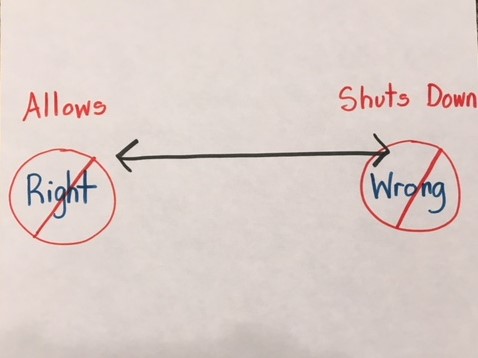
Stephanie Jones, professor- and coach-extraordinaire, worked with a group of us coaches several years ago. Among the most impactful concepts she shared was letting go of “Right” versus “Wrong” and instead considering what each decision Allows and Shuts Down. 


Every decision you make as a teacher (as a human, really) allows certain things to happen and shuts down other things. For example, consider the way you set up your classroom. You might push your students’ desks together in groups – this allows for more teamwork and better table-space for project work. But it shuts down some students’ ability to easily see the board (if their back is facing the front) and it might encourage student talk during those times you’d rather they listen to you.

Or think about strategy-based reading groups, which is when you meet with kids reading at different levels and teach them a strategy before conferring with them individually. This approach allows you to provide targeted instruction regardless of reading level, thus giving you flexibility in forming groups. But it might shut down a common conversation that would be easier if everyone had a copy of the same book.

In other words, strategy groups aren’t “wrong,” but they’re not always “right” either. You make your decision as a teacher based on what you want to allow for your students at that moment. The key is understanding that every decision you make simultaneously allows and shuts down certain things.

Unfortunately, we will never Arrive at a point in our careers where we have this thing all figured out. We will never create the ultimate set of plans to save from year to year that will suffice for all students all the time. We will not find the One True Way to teach.

The sooner we realize this and embrace the messiness of working with young minds, the sooner we can be kind to ourselves and find the joy in teaching.